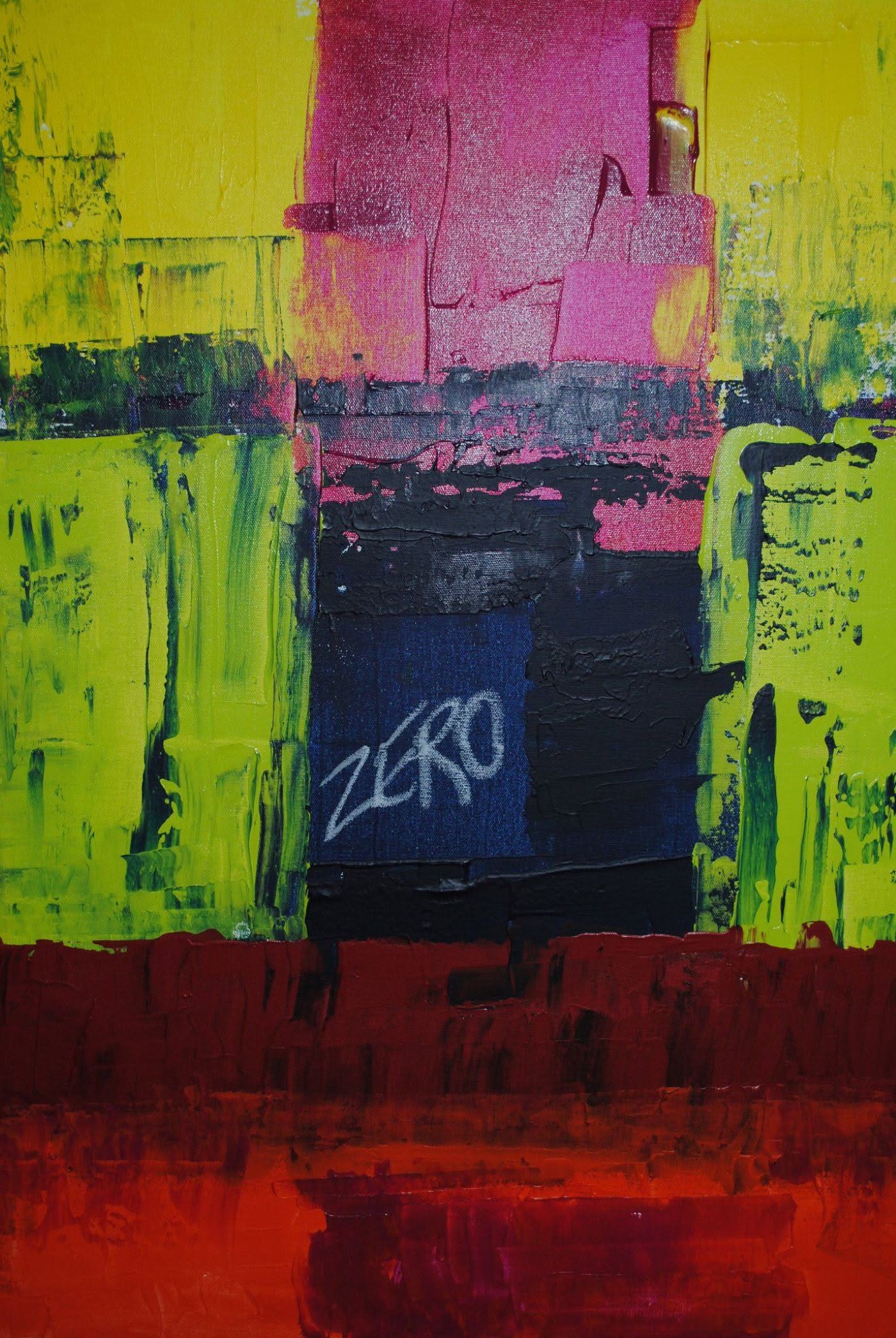
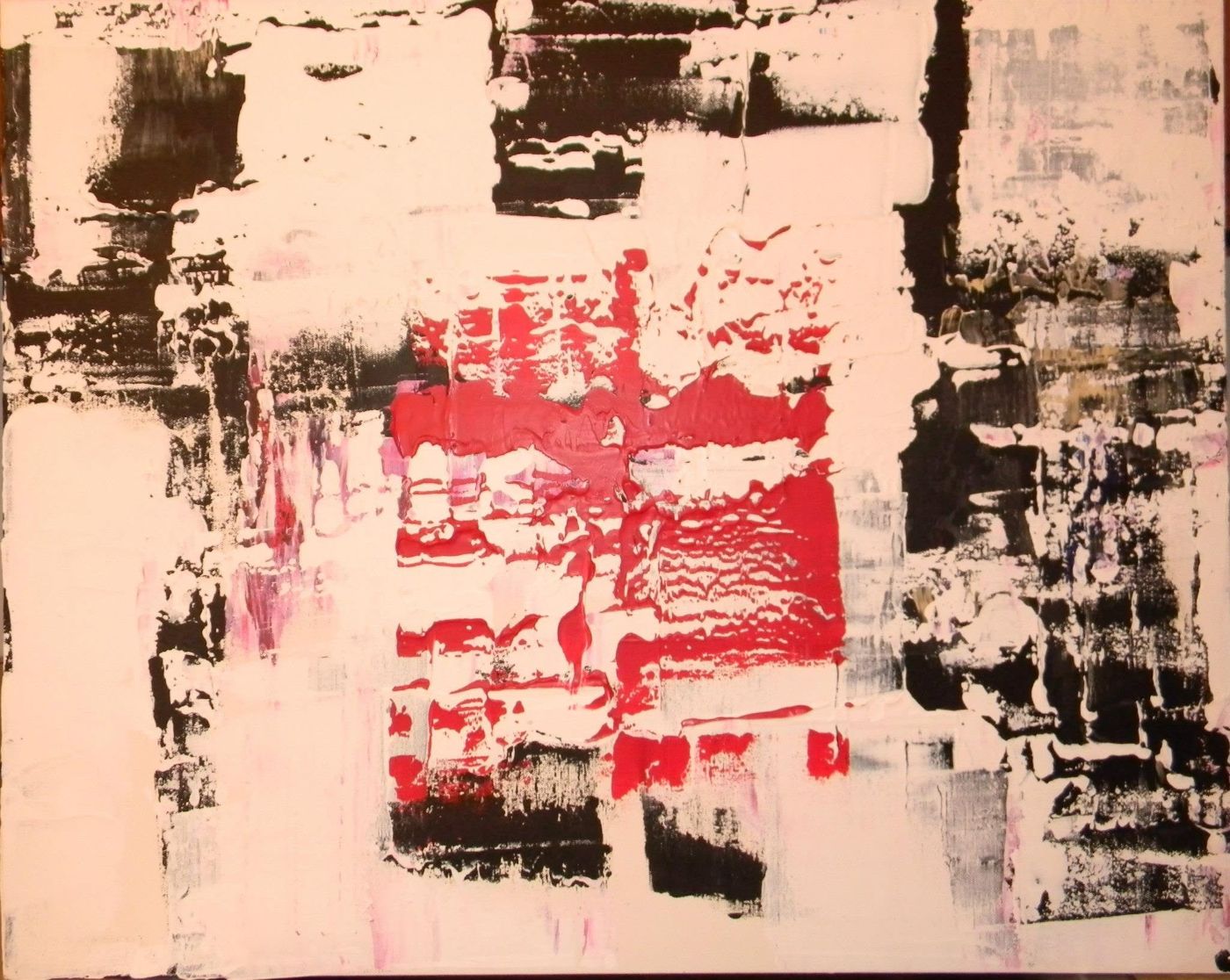
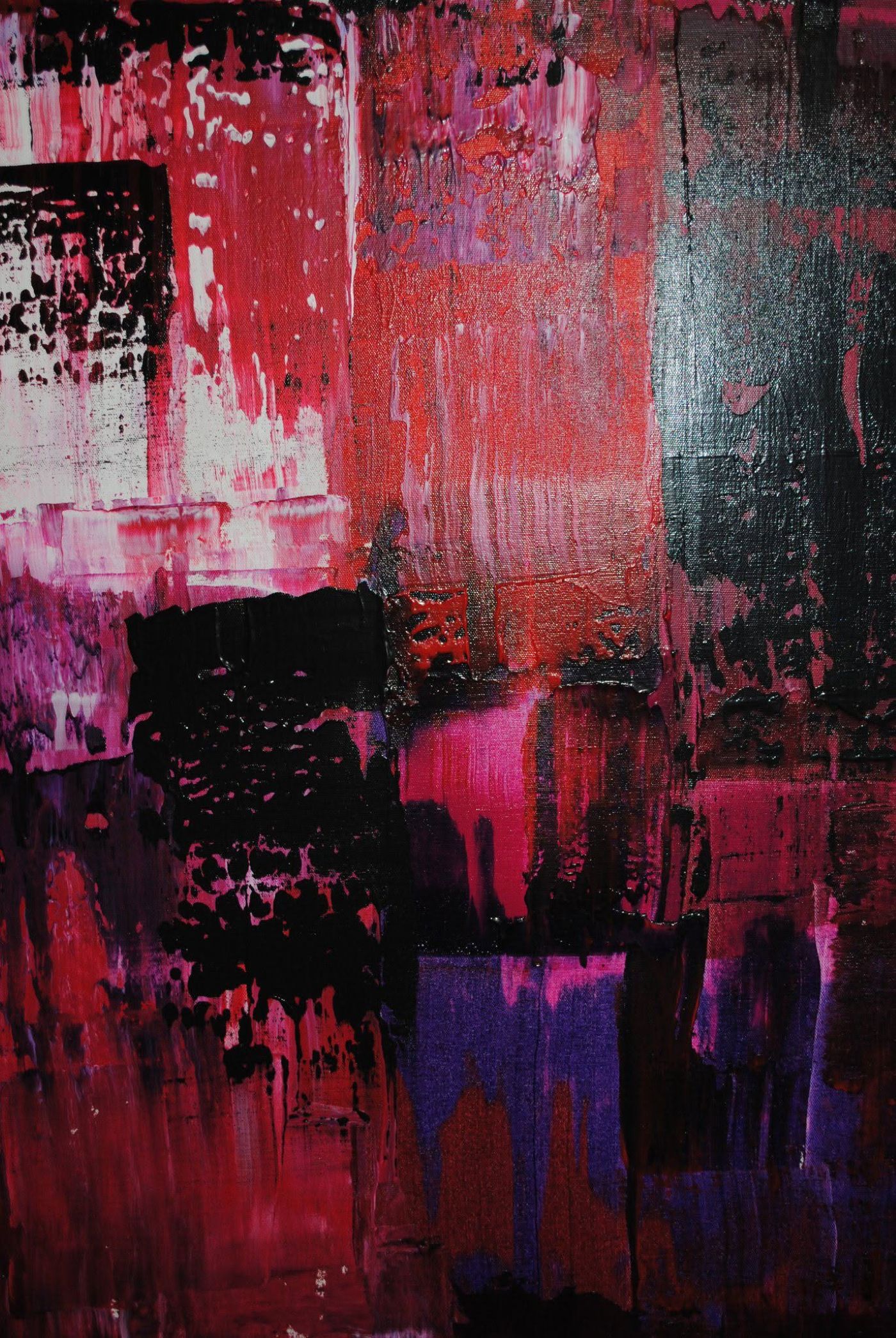
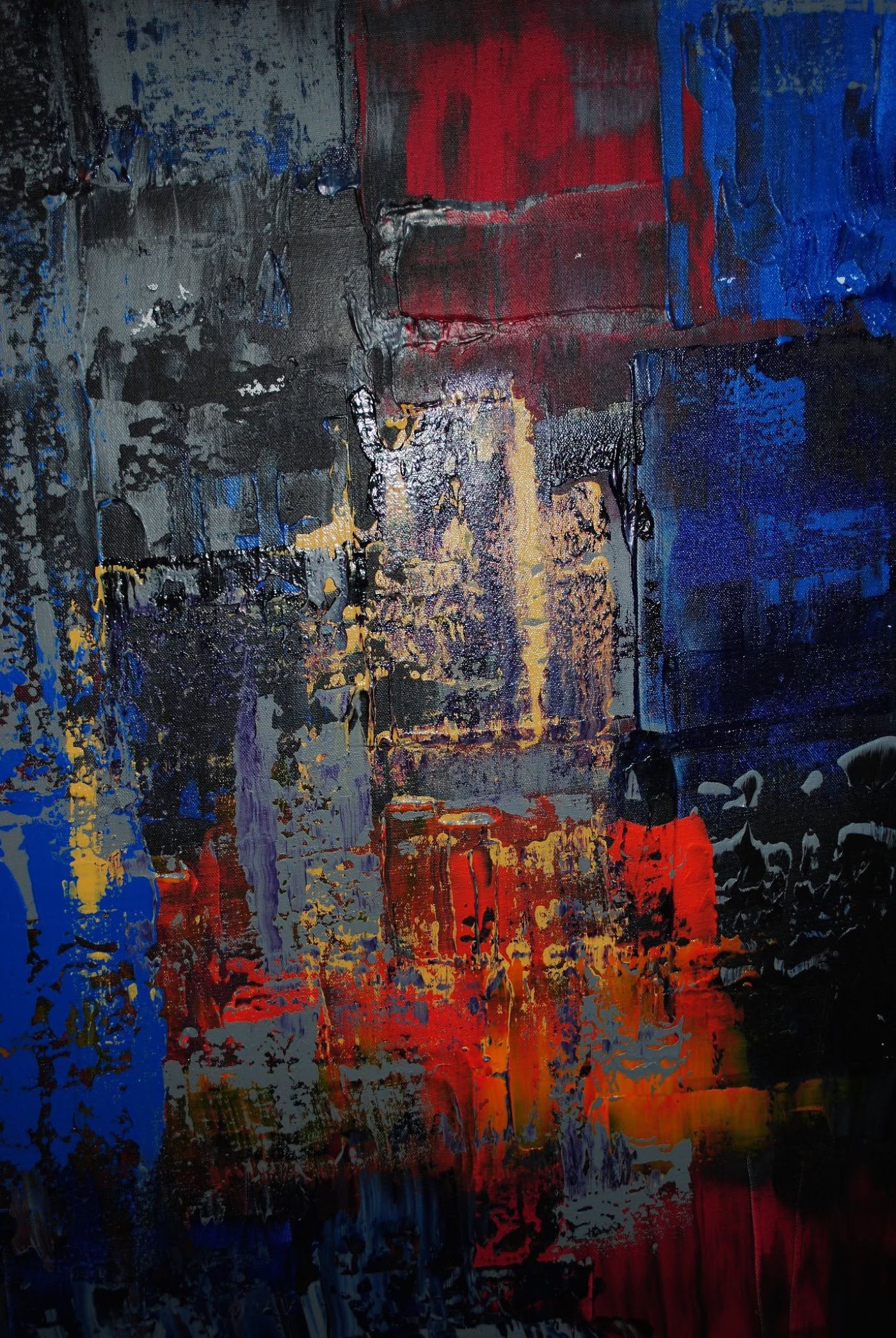
When I started this blog back 2010 my idea was to give as much coverage to artists, writers, musicians who hooked me. The artist Edward C. Zacharewicz hooked me. I found his paintings by chance on one late night surf of social media. I contacted him. We exchanged messages. We developed a rapport. The following interview came from there.
Planet Paul has always been a personal blog. I kept it going till around 2015 -16, when my commitments to Dangerous Minds, Flashbak, and a few other sites meant I didn’t get the time I needed to keep PP ticking over. I shut it down. Put it into hibernation.
Then in 2025, I decided to relaunch this site as an occasional blog which would slowly grow to something regular and hopefully successful.
I deleted nearly all of my old content (pages are still available on the Internet Archive) but kept the interviews. What people do and what they think and how they produce their art, music, words, films is important to me. I will be republishing the interviews in an ad hoc basis starting with this interview with Edward C. Zacharewicz.
When we corresponded, Edward had not long reconnected with his career as an artist after a twenty year hiatus. He told me there were many reasons for this break. Life. Marriage. Family. Good things. He “wanted the white picket fence.” Time moved on. Things changed. But the need to paint was constant.
In 2009, Edward started painting again. He exhibited his work in galleries across New Jersey. He produced more and more paintings. He was experimenting, developing, progressing. Then in 2012, when things were looking good and Edward was close to having his work shown in New York, he died. What could have been, we’ll never know. But what Edward left us, we should be grateful for.
The following comes from our interview first published in June 2010.
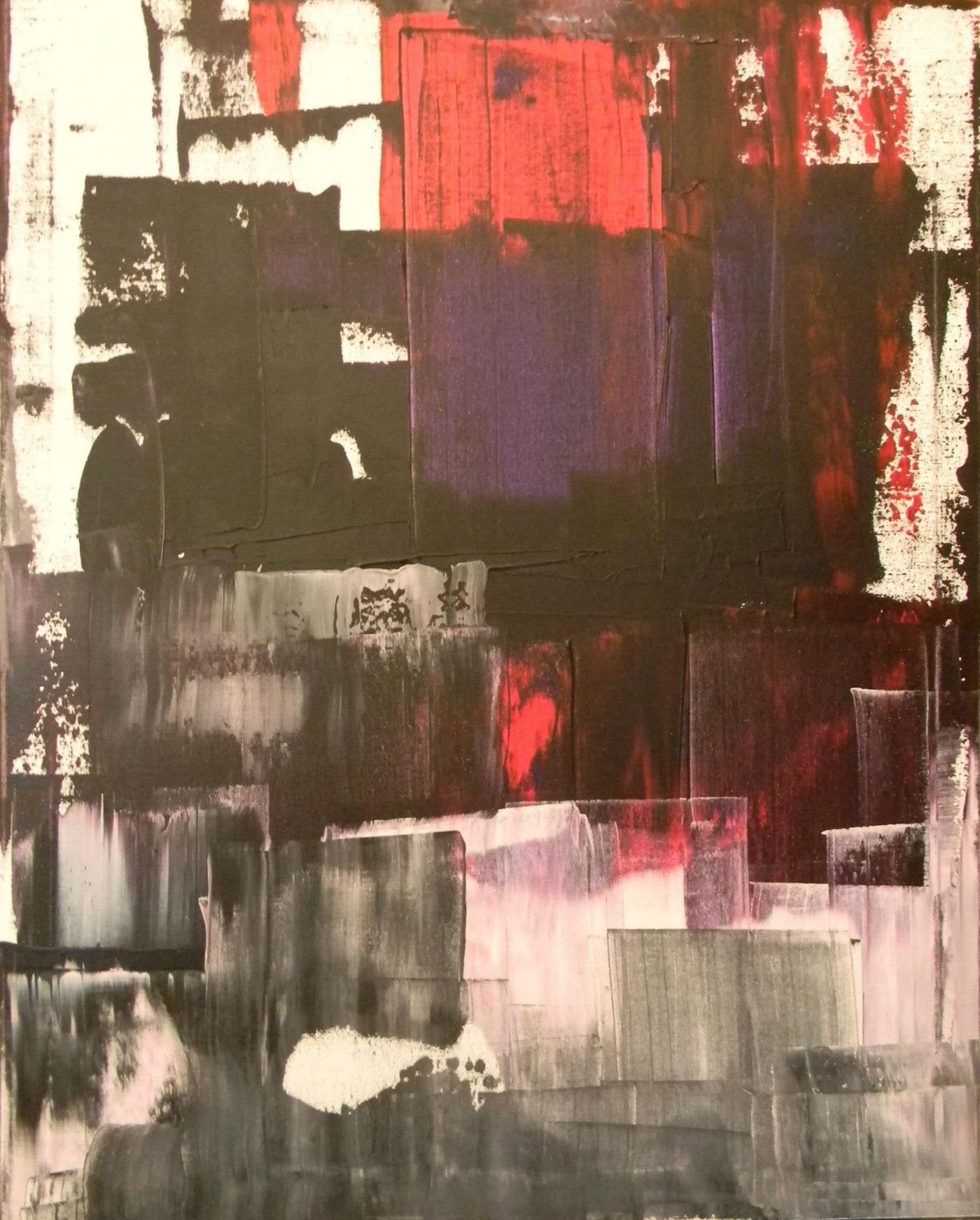
My Hero, (2011).
The artist, Edward C. Zacharewicz has a large collection of antique paintings and religious prints. The collection is a reminder of the images from his childhood. These inspired him to start painting.
‘I was kid and going to Catholic Church with my parents and sitting there and just looking at the paintings and murals and how beautiful they were.’
It was the colours of the paintings – the bright flame of the Sacred Heart of Jesus, the royal blue on the dress of the Blessed Virgin Mary, the scourged body, the pierced side, the hues and textures of the crucified Messiah.
Last Night in the East Village (2012).
Colours were important even then. His parents bought him painting-by-number sets and Edward filled them diligently.
‘I always enjoyed colouring, still do. I actually didn’t start to draw until I was eight or nine years old. I think it was working with colour that led me to paint in the style I do.
‘Colour can show much emotion without being in a physical form.’
Zacharewicz’s paintings distil experience into art.
When you look at a Zacharewicz, you can understand why his favourite painter is William Turner, the man he describes as ‘the master’.
Turner was the ‘painter of light’. His work anticipated Impressionism, and his use of brush on canvas suggested elements of Abstract Art.
Zacharewicz creates layered puzzles which use layered colours to unlock their power and meaning.
‘All my paintings have to do with something from my life, a situation, a feeling, a thought, a person or place. I never decide, it just happens. I have a title for the work before I start.
‘I really don’t have a routine….sometimes I go weeks without painting, then all of a sudden I get this burst of wanting to paint…it might be a situation, it might be a spoken word.’
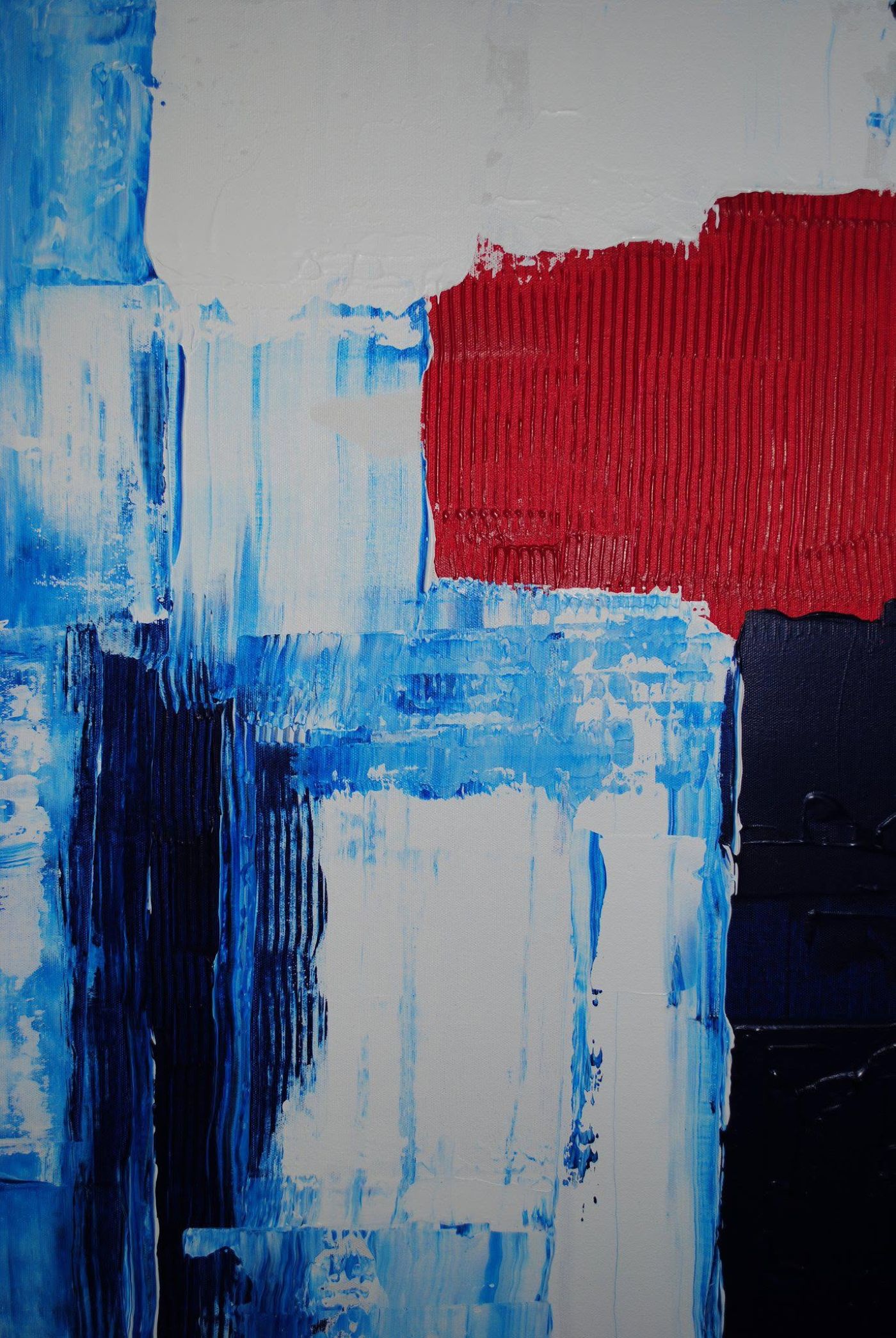
It’s Not That Kind Of Party (2010).
One of his paintings was inspired this way.
Edward C. Zacharewicz: It’s Not That Kind Of Party came from a conversation I was having with my friend Jessica Paris, who is the singer for Honey Spot Blvd.
I don’t even remember what we were talking about, but somehow what was said in the conversation and I told her I was going to use it as a title for a painting. The colours I used were based on her – bright, happy colours that work well with others.
Sometimes, it takes me days to finish a painting. Then there has been times were I have finished one in a few hours. It depends on the colours, if I want to blend them, layer them, or drag them.
I basically paint with acrylics, sometimes I do add oils to a painting because I love the texture it can give. Also on some I have used oil pastel crayons for a different look.
There are times when I look at a painting for a few hours figuring out if it is done or not. But, I always know when it is finished..
Why did you stop painting?
ECZ: I really don’t have a true answer for that, it just kind of happened. I went from painting then to drawing in a sketchpad, then to writing poems and lyrics. Also, I was working a lot so I actually didn’t have a fair amount of time to really concentrate on my art. But, I always kept notes about paintings that I would want to do when I did start again.
Violet, (2010).
At the time of this interview, Edward’s work was in great demand. He was talking to New York galleries and had plans for shows in Europe. His work had also been used on the cover of a Honey Spot Blvd CD.
ECZ: They are a very talented band of musicians as well as wonderful friends and always very supportive of my art.
I recently finished a photo/painting project with an amazing photographer Kristine Diven. We chose one of her self-portraits and I attached it to the canvas and did a painting around it. It really is a wonderful piece.
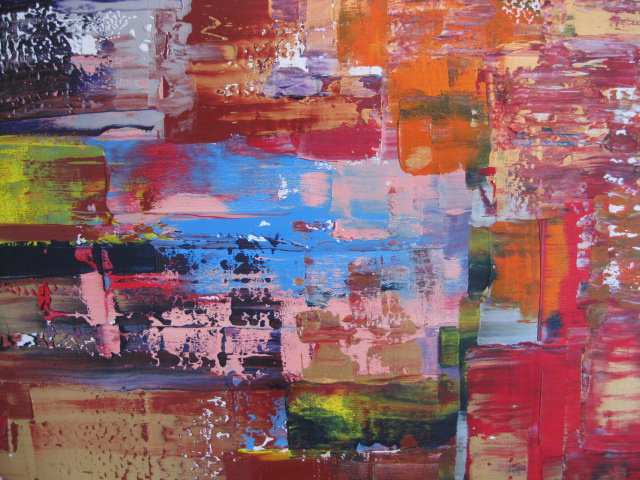
When She Left, I Crumbled, (2011).
Edward was also working on a year-long project with West Coast artist Jeremy Guffey.
ECZ: Jeremy wrote a poem and sent it to me, we are each doing six different paintings inspired by the poem and not letting each other see them until the series is done, and that will be in finished in late October. Finally, I am trying my hand at using pastels and doing abstract landscape drawings and well as doing some photography.
Jumping from a Basement Window, (2011).
Plans become memories. Too often forgotten.
I hope reposting this short interview with Edward C. Zacharewicz will rekindle an interest in his art.
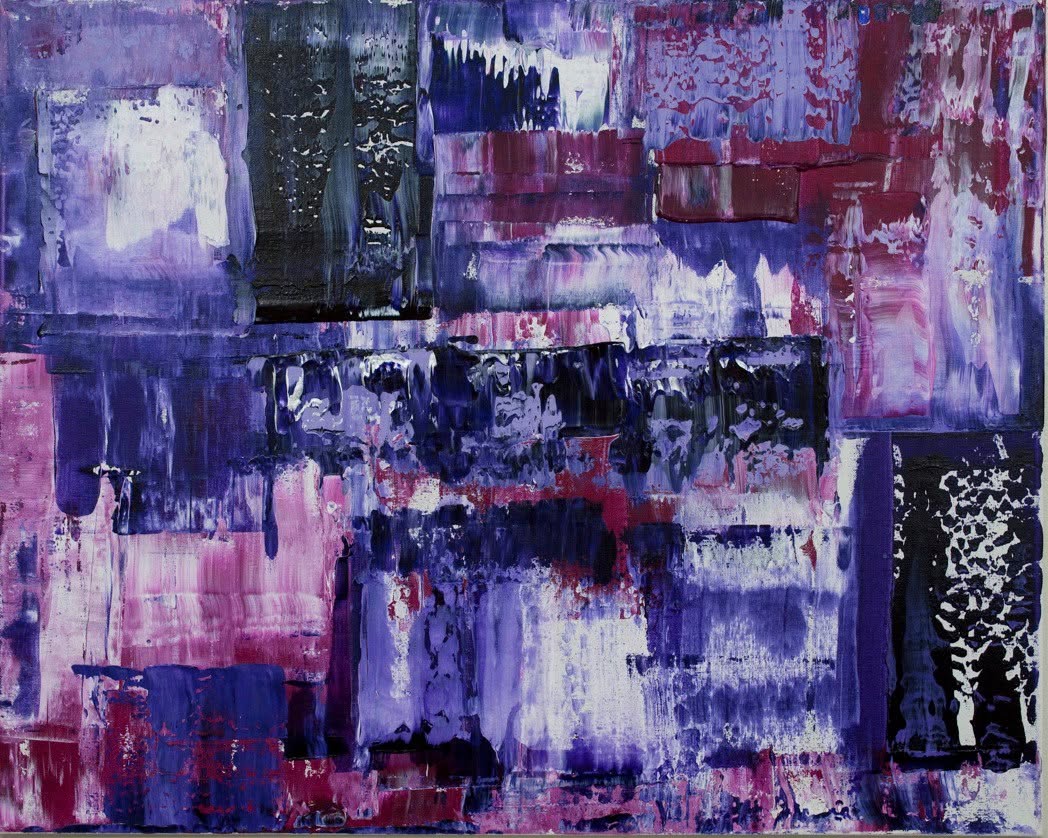
Velvet Lies and Tattered Heart, (21011).Smoke Follows Beauty, (2011).
Micheál Jacob is a writer, producer and script editor who has worked on many highly successful comedy shows such as Birds of a Feather, Goodnight Sweetheart, Two Pints of Lager and a Packet of Crisps, The Smoking Room, and My Family amongst many others.
How did we meet? That’s the sort of question which has been answered in the pages of glossy supplements for years now. I met Micheál across a crowded office. The Music and Arts department at BBC Scotland circa 1989. We had both been hired as Assistant Producers.
Micheál had relocated from London. While I had moved up one floor from General Features. I was twenty-something. Micheál was whatever age he was. Older. He wore a jacket, shirt and trousers. It would be rather strange if he hadn’t been wearing trousers. I hadn’t as yet evolved into wearing a suit so was probably the same. We connected because we both smoked cigarettes, liked drinking wine, and shared similar tastes in books, music, and film. I was in an on-again, off-again relationship with a beautiful and talented woman. Micheál was recovering from a folie a deux with an unobtainable dream. He was a gourmand while I was a barfly who spent too much of my spare time in the long day’s journey into a pint.
We are both of Irish descent. Micheal closer than me. We discussed the novels we weren’t going to write and searched for the perfect opening sentence. Declamatory like Auster? Or clever like Joyce? We often found ourselves in the Ubiquitous Chip sometimes in the company of brilliant writers like William McIlvanney and Peter McDougall as we danced in conversation around Morag Fullerton’s handbag. These were good times but my friendship with Micheál didn’t really take-off until he left BBC Scotland and returned to London. We wrote long A4 letters to each other about nothing in particular but everything all at once. Reports from the front wherever we thought the battle may be. By then Micheál was working as a script editor on Birds of a Feather which as any fule kno, is just one of the many classic series written by the brilliant writing partnership of Laurence Marks and Maurice Gran.
As you will find out later, Micheál, Laurence and Maurice had once been in a band together which almost made it. Well almost. This was before Lo and Mo earned their stripes writing comedy routines and sketches for Frankie Howerd, then went onto achieve tremendous success with Holding the Fort, Shine on Harvey Moon, Birds of a Feather, The New Statesman and Goodnight Sweetheart.
Micheál script edited a couple of those series before he served as Creative Head of Mainstream Comedy at the BBC. Now he produces one-woman shows for a friend in Manchester, does some consulting, some teaching, some writing, some editing and a bit of development here and there. He also co-created and produced an online audio sitcom, and has script edited nearly 40 dramas for BBC Radio 4 and Radio 3.
To put it simply, Micheál is an all-round good guy.
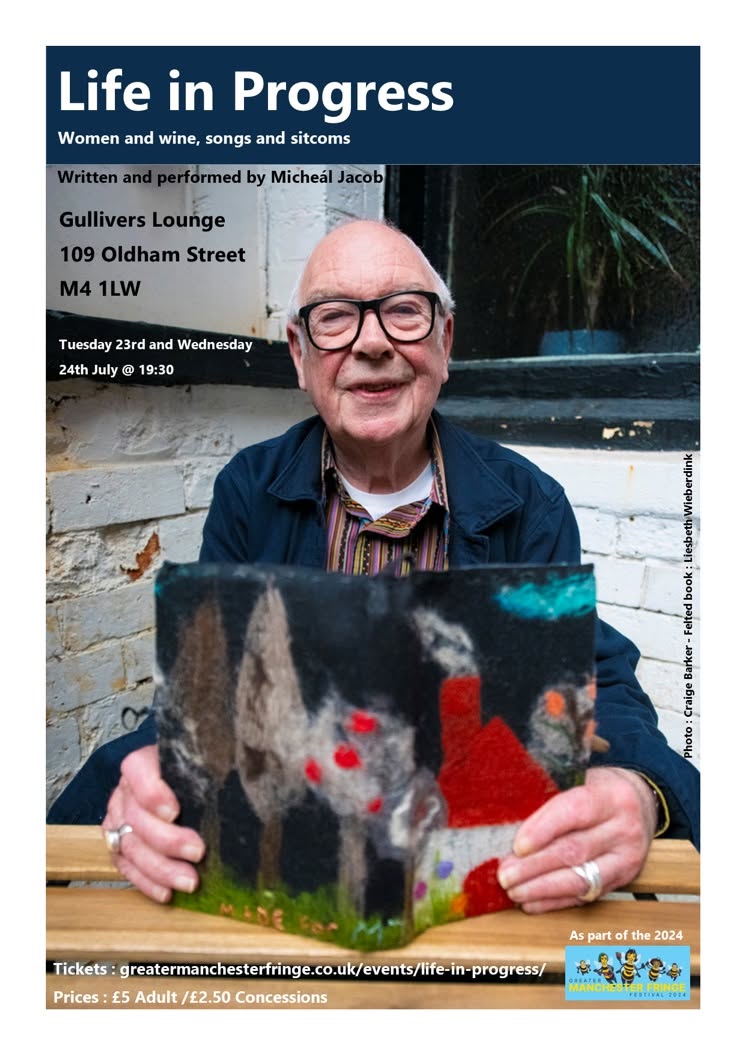
In 2024, Micheál performed his one-man stage show Life in Progress as part of the Manchester Fringe. What follows is an extract from this highly acclaimed show.
Micheál Jacob, photograph by Craige Barker.
LIFE IN PROGRESS
Women and wine, songs and sitcoms
When I work on a script out in Didsbury/It’s always a very good week/Makes me think of my friends back in TV, and the others of whom I won’t speak/How I used to wander on a Sunday, and my wages on Beaujolais spend/And then I would lie until Monday. with my red-headed Kate in Crouch End
May the ghost of Dominic Behan forgive me for adapting his song…
Once upon a time, say 1890, there was an accountant in Belfast called Billy Long. He had a young wife who died tragically, he went to Douglas in the Isle of Man for a holiday to cheer himself up, met a Lancashire Lass called Alice Aldred, they fell in love and got married.
A new wife inspired a fresh start, so Billy took Alice to Waterford in the south of Ireland where he got a job as chief accountant in a department store on the quayside, and they had a family of three girls. The first was Nell, the glamorous one, who sang and danced in end of the pier shows. The second was Bunty, who was the sensible one.
Then later on there was Wendy, who Alice didn’t really want and who gave her postnatal depression. Which wasn’t a thing in 1920. Alice took to her bed, and Wendy was sent to cousins in Cheadle, for reasons she didn’t understand. The girls grew up and the family moved to a seaside village with a three-mile beach called Tramore, which in Irish means ‘big strand.
Their house was called Arcadia. Nell met a brewery manager from Somerset, had fun in the sand dunes, got pregnant, got married and moved to England where she had two more children, then moved back with them to Arcadia, saying that her husband was an abusive alcoholic.
Bunty met a dashing sales rep with a fast car who swept her off her feet. They got married, and the dashing sales rep handed back the car, abandoned work, and never had a job again. They rented a bungalow three minutes away from Arcadia, where Bunty spent the rest of her long life.
As soon as Wendy left school she did a catering course in Dublin, got a job in a big house in Galway as a cook, and joined the British army when war broke out. Tramore wasn’t where she wanted to be. She worked her way up to being a Captain.
Then she met an older Major called Mark Jacobs. They bonded over The Times crossword in the officers’ mess, and when the war was over they got married. The major was a jolly Jew who loved the music hall – particularly Max Miller and Flanagan and Allen – and whose family owned and drove black cabs. Instead of getting the sort of job a major might get, he was happy driving a cab and going to the music hall. Which of course meant irregular hours. Which is why, when Wendy was going through his drawers and found a cache of letters from another woman with whom he had a family in Edgware, the irregular hours made sense.
So Wendy, like Nell, went back to Arcadia, discovered she was pregnant, and that’s where my once upon a time begins. Naturally I don’t remember the event, which was the week before Christmas. It was the coldest winter on record and I couldn’t be taken outside until February. Which perhaps explains why, when I encountered central heating for the first time many years later in Glasgow, I burst into tears.
Grandad Billy had died during the war, and Grandmother Alice had become a semi-recluse, spending most of the time in her room. She was a spectral presence, and one of my first memories is being told: “Ssh – granny.” Then one day I didn’t need to shush because granny died and I wasn’t allowed to go to the funeral.
So there we are, Aunty Bunty married to my deadbeat Uncle Sidney, a loud man who never got up before ten o’clock; Aunty Nell with a fatherless family and no visible means of support; and Wendy, my mum, who was a single mother at a time in Ireland where single mothers weren’t viewed very favourably. If we had been Catholics, who knows where she might have ended up and whether I might be here at all? But we were Protestants. And the story was that my father had died in the war. I was an only child in a world of women who loved me unreservedly.
When I was four, my mum got a secretarial job in Waterford with an older man who had an invalid wife. She would come home smelling of Lily of the Valley, cigarettes and gin to kiss me goodnight. Wendy and older men… It wasn’t a very sociable life, probably because we were too hard up to entertain visitors, so we didn’t have any. We had credit at the shops in the village, which was sometimes a bit embarrassing. There were discussions about whether or not there was enough money to light a fire. There were icicles inside my bedroom window. And there was a memorable night when Mum and Aunty Nell were very down and really fancied a drink. Which meant Mum going to Robinson’s bar, poking her head round the door, Mary Robinson coming to see what she wanted, then mum waiting outside for a brown paper bag, bearing it home and splitting a bottle of Guinness with my aunt.
When I was ten, my mother thought I should go to boarding school to escape from the all-female influence and experience a manly life.
It felt like a betrayal, being thrown into a world for which I wasn’t at all equipped – big scary boys, big scary masters, a big scary building which was an architectural masterpiece and as far from central heating as you could get. It was called The King’s Hospital, known as KH, and a long way from Arcadia. The Headmaster was past retirement age and straight out of Dickens. He loved beating boys who stepped out of line and making them cry. His evil sister, the Matron, didn’t believe in illness. She was also in charge of the catering. Even now I can’t face shepherds pie, which involved a week’s assorted leftovers with burnt mashed potato on top. It was a school mainly attended by farmers’ sons, so I became rather an expert on combine harvesters. In the farming context, I was a bit exotic and, strangely, a pretty boy. The English teacher encouraged my writing, allowed me to go to the theatre and films, and fiddled with my ear in class. The French teacher was friendly and loaned me books. The master in charge of cricket realised I was crap at sport and made me scorer of the junior team, which meant trips out, and nice teas.
The music teacher, who oddly wasn’t gay, liked my voice and put me in the choir. There were boys who weren’t scary and became friends. And then, when I was 14, my mum met the third of the four older men in her life, got a job with him in London as the Sixties were beginning to swing, and from priest-ridden, history-addled Ireland I was transported to the centre of the world, at least during the holidays. London was a place where to find accommodation you looked at small ads in the evening papers and newsagents’ windows, and these ads said, in varying orders, No Blacks, No Irish, No Jews, No Dogs. So mum dropped the ’S’ off Jacobs because there were Quakers in Waterford called Jacob who made biscuits.
But that didn’t stop us being proud of being Irish. A semi-local folk group, The Clancy Brothers and Tommy Makem, made a success in America, which was wonderful. An architect from County Tipperary, Sean Kenny, revolutionised theatre design with Oliver. And then were was our own local hero Val Doonican, who brought Waterford to the world. And contributed greatly to the knitting industry. I’m not sure this song is entirely suitable for nowadays, but:
(Sings Agricultural Irish Girl)
Oh she’s a fine big lump of an agricultural Irish girl She neither paints nor powders and her figure is all her own But she can hit that hard – ow! – you’d think was a kick of a mule you’d got
The fill of your arms of Irish love is Mary-Ann Malone…
I still keep my first passport, with its stiff covers, that I got when I was fourteen. That was the age when I started to think about what I wanted to do with my life, and it was certainly the age when I started thinking about naked women. Quite a lot. I wouldn’t have known what to do with a naked woman if one had suddenly appeared, but I had an idea it might be fun to find out. Later on, my mother said she had considered walking around naked when I was little so as to remove the mystery, but I’m rather pleased that she didn’t. I have enough neuroses as it is.
It was a strange period of life – it felt as if I was in a waiting room, uncertain when the door to the inner sanctum would open. In retrospect, my Dickensian school took considerable steps to hire maids and domestic staff who would never awaken a young man’s fancy, and just in case dressed them in shapeless overalls and forbade make-up.
One day, there was a new recruit who, even without make-up, caused something of a stir. Unlike the other maids, who were country girls, this one came from Dublin and had a rather street-wise air. She was also prepared to chat when the matron wasn’t looking, and she seemed to take a shine to my friend Doug and me. Perhaps we just amused her.
One night Doug and I were in the infirmary, both suffering from flu and feeling pretty miserable, when the magic maid appeared. She was wearing street clothes, and perfume, and make-up – it was like a fever dream. She said she had come to say goodbye. She was sneaking off to catch the night boat to Liverpool to meet a man she had been writing to. She wanted to say goodbye because we had talked to her like a human rather than a skivvy, and she hoped that one day we’d be as happy as she was. And then she disappeared, leaving behind a strong smell of perfume and a feeling that the waiting room door had opened a notch, and I had been granted a vision of what lay beyond, before the door was closed again.
Sadly, Doug is no longer with us, though we had kept in touch. When there was a gap between emails, one or other of us would begin the next one with – are you still alive? That’s how I began my last email to him. The reply came from his wife, to say that he wasn’t.
When I left school I got a job in a publisher’s post room, mainly packaging books, picking up or delivering manuscripts, and collecting the mail twice a day. The head of the post room was a Maltese man called Tony, who was a Junior Mister Universe, and used to sit on a roll of corrugated paper popping supplements and flexing his biceps. He hadn’t really grown much since his junior days and was too small for the real thing, which weighed heavily on his mind. Then there was Martin and Mike. At the end of my first week, when we had been given our pay envelopes, I discovered that the tradition was to walk into Soho, go to a pub and have a pint, then go to a strip club. My reaction caused a great deal of hilarity. “But I’m seventeen,” I said. “Will they let me in?” They said there would be no problem and there wasn’t. So there I was, in a small dark room upstairs in Soho, full of men all looking rigidly ahead and not making eye contact, waiting for something to happen. There was a clatter of heels, the needle dropped on a record and a young woman appeared.
She gradually removed items of clothing, making artful use of a feather boa. And finally removed her g-string as the song ended and the lights simultaneously went out. The heels receded, the men stayed where they were, and my colleagues were very keen to know what I thought about my first naked woman. I said something equating to ‘phowar’, but my heart wasn’t really in it and remained untouched when we left after the next few acts. It was all a bit disappointing really. I had expected … well, I’m not sure what I’d expected – some kind of thrill, some frisson, some sense of transgression. Instead it felt rather tawdry and sad and as far from erotic as you could get. I found an excuse not to go the next Friday night, and then the next Friday and then it was accepted that I wouldn’t be joining in.
Not long after, the personnel manager, Miss Thorp, called me in for a chat. She was quite a frightening woman whose passion was keeping younger staff members in line. She had sent my friend Jenny home because her skirt was too short. I wondered what I had done wrong. But she asked if I’d be interested in becoming a trainee publisher on their scheme? Some of the senior people thought I might have a future beyond the post room. It would mean moving to Glasgow. So I thought why not?
The company had an accommodation list from which I and the other two trainees – both public school English boys with whom I had very little in common – picked lodgings. When I went to see mine in the evening after work it was very dark and smelled of mould, was freezing cold, and the landlady was rather unsteady on her feet. She showed me the room, I said I’d take it, because I had nowhere else to go. She left, I moved over to the bed, kicked something that clinked, and discovered a large stash of empty gin bottles. The next day I explained the situation at work, they found me somewhere else, and that was when I forged my lifelong relationship with central heating.
It was in the summer that I set out on a night train to London for a week’s holiday with my mother. A night train seems a bit weird in retrospect – perhaps I’d done a day’s work and wanted to get away as soon as I could? In any case, I‘d settled myself down when a girl came and took the seat next to me in the compartment – there were compartments then rather than open plan, you could open the windows, you could smoke. Different times. As we rattled south and it got past midnight, just I and the girl were awake. We’d got on immediately and were chatting away. She said her name was Silé.
She had lots of silver rings, wore floaty clothes and a white mac stained with fake tan, and told me she was a poet. She was going to Cornwall for the summer to meet other poets and musicians to sleep on beaches and have a good time. I thought she was fascinating, and we were getting along well, so it wasn’t entirely a surprise when we stopped whispering and started kissing. Everyone else was asleep. I hope. Silé sat on my knee. What happened next was rather more of a surprise, something of a shock and for me a unique experience. Though for obvious reasons Silé kept most of her clothes on. Not quite my 14-year-old dream. Probably better. We wrote letters, because that’s what you did in the 60s. She sent me poems. I’ll always remember one thing she wrote – “I want to be thin, and pure, and kind. To everyone.” When she got back to Glasgow she said it had been a wonderful summer and now she was going back for her final year. We saw one another a bit, but it all fizzled out when normality kicked in. How can you repeat the magic of a brief encounter on a train?
But naked women were the just one of three things on my mind when I was fourteen, because I decided I was going to become a pop star. All it seemed to need was the ability to sing which I could – and a guitar.
So I asked my mum if she would buy me one. Knowing very well that I wasn’t great at perseverance if things didn’t come easy, she said she would buy me a ukulele, and if I learned to play that, she would get me a guitar. Somehow the ukulele doesn’t lend itself to rock and roll – it’s hard to strike rock god poses with a little instrument – but rather to my surprise, as well as my mother’s, I mastered it quite quickly. So I was able to go to Charing Cross Road with some money in my fist and come home with a guitar. It was so exciting. I formed a band at school, which I think was probably crap. One of the others had a very expensive electric guitar with a tremolo arm, but he was rubbish. We had a falling out over his ability to keep time, and then a massive falling out when he played the female lead in a play that I wrote and directed – in a boys’ school we had to take a Shakespearean approach to casting. He could never remember his lines, didn’t take notes very well, and I ended up playing the part myself in a blonde wig, what I realise now was a rather brief miniskirt, and lots of tissue paper in a bra. For the term after that I was known as ‘legs’.
Being in London and not yet having any friends, I had a lot of time to occupy, so I took to hanging out in folk clubs. When I began, like nearly every young male folkie at the time, I wanted to be Bob Dylan rather than Val Doonican. I wrote very meaningful songs, that were either about why I’d been dumped, or why the girl I liked didn’t seem interested. Lots of pain! They were the sort of nights where a couple of people had been booked – and how we envied them getting their five quid at the end of the evening – and the rest of us got three numbers to see if we’d get the nod for a booking next week. Weirdly, despite being a genius, it never happened, so I teamed up with a new friend Andy to see if a duo might do better.
He had a rich family and thus owned a Mini, which was very cool. The problem was that he was brilliant when we were rehearsing but had crippling stage fright in front of an audience. Though probably the bigger problem was that we were both big fans of Leonard Cohen, and we named ourselves after one of his novels – The Beautiful Losers. Sort of a death wish really. Plus he did a lot of acid, and had a very bad trip on the night that a friend needed support after having had a much older lover die in her bed. Andy and I were meant to be cheering her up, but he was having a bad trip, so we ended up looking after him, while he demanded to play a miserable Neil Young song over and over again. I feel helpless, helpless, helpless A fun night!
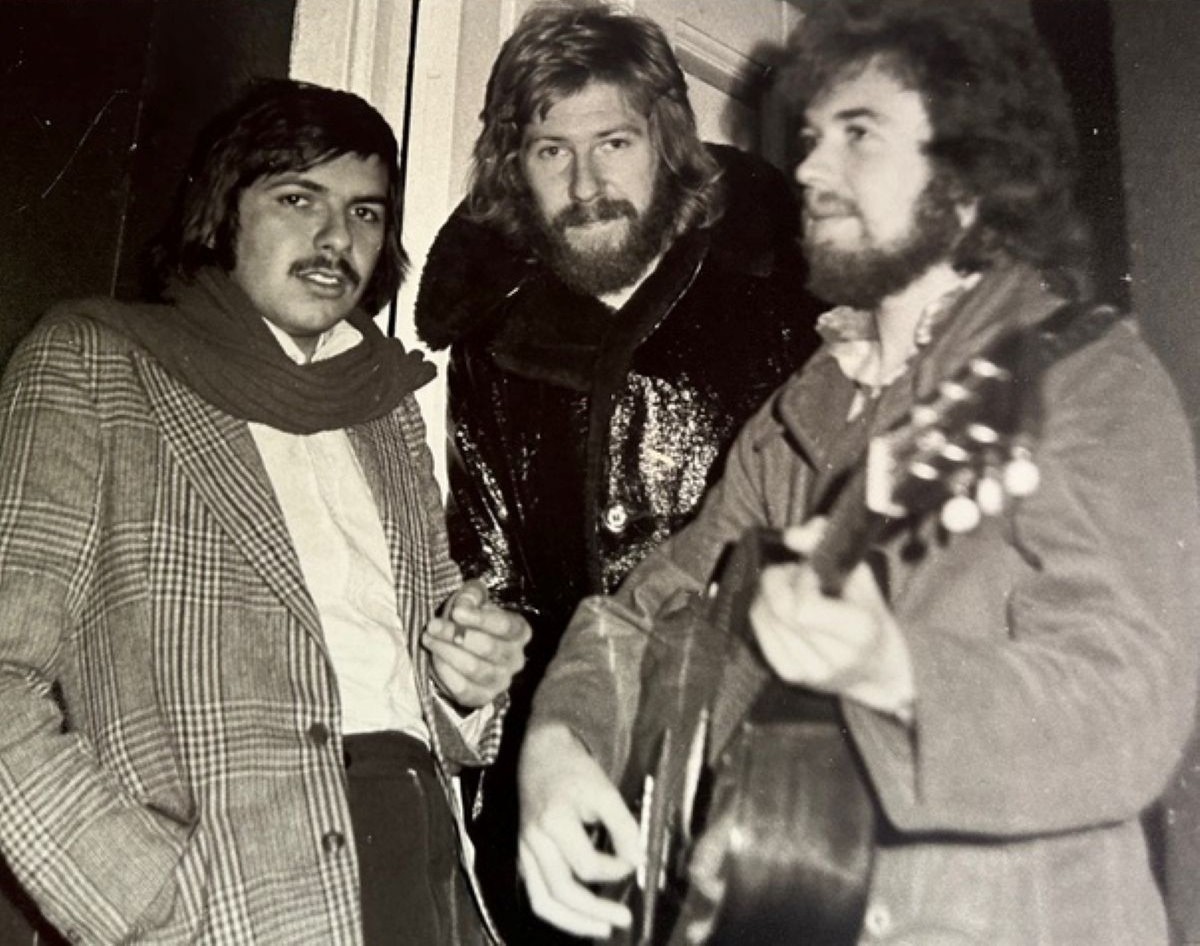
After that we parted musical company, so after being a single performer, then a duo, logically the next step was a trio. There was a Mod bass player where I worked, and his cousin played drums, so we thought we’d do some practising and see where it went. The cousin was actually a really shit drummer, but he had a car that would fit his drums and the gear, so basically he was in. The bass player was called Laurence Marks.
Maurice Gran, Laurence Marks, Micheál Jacob.
Now this was the late 60s, and bands had names that suited the period. There was Pentangle, for example. Wow man! Ace of Wands. Groovy. And we were called Ethos. Like … wild! I wore a kaftan, and sometimes a bell. Honestly, bells were a thing. We actually got some good gigs, we had a manager who, foolishly, thought we might be successful, and we acquired a roadie called Mick, a big bloke who had a van – a proper van! Now life is fine if it’s just you and a guitar, but if you’re doing okay and acquiring bigger and better equipment, then you need transport and a van felt like big time!
It also helped that Mick was a big bloke, because generally wherever you played, the promoter would say it had been a disappointing night and offer less than the fee you’d agreed. So we’d hide in the van with our artistic temperaments, knowing that Mick would emerge with the money. Ethos gave me one of the few memorable moments of my life in music – well, one at least worth passing on. We used to do a mixture of my originals (why did she dump me? Why won’t she shag me? It didn’t change much), and what weren’t then called covers of other people’s songs. Paul Simon was very big on the English folk scene at the time as a solo act, and was very much revered … as well as resented … fuckin’ Americans, coming over here, being better than we are. He had a solo album – nobody else had an album. What a bastard! One night we were playing at a club called Les Cousins, which was meant to be pronounced the French way, but was known to everyone as Les Cousins – and I was singing one of his songs, The Side of a Hill.
I was giving it all the sincerity, when Paul Simon walked in, chatting with another bloke. He sat down at a table just underneath the stage, and they kept chatting away. At the end of the song he got up to continue his conversation at the bar! He talked through the rest of our set, left as we were getting our applause, and never looked at us! So I’m afraid Paul Simon is dead to me. And I’m sure he has regretted his rudeness every day since. Bastard!
After that the drummer, who was an accountant, decided he needed more regular hours, so the bass player introduced me to a friend from his Jewish Lads Brigade days in north London, who played keyboards. He was called Maurice Gran. We became more poppy and less folkie. Our manager called us Spoon because we reminded him of a knife, a fork and a spoon, which we could never work out. But we were the only cutlery-based band around. Unlike Ethos we combined Spoon with day jobs, but there was always that dream. And it felt like coming true when we did a gig with a singer and songwriter called Labi Siffre, who wrote a beautiful song that has really lasted called Something Inside So Strong. We got on really well, and he was very big at the time, so when he asked if we’d go on tour with him as his support band, it was an incredible opportunity.
But the bass player was just about to get married, the keyboard player was just about to get married, and I was in a relationship heading towards marriage. My now ex-wife was all for it, but she was and is quite unconventional. She worked for an aid agency and went to lots of dangerous places, and she gave me a very useful tip – always sit at the back of a cafe, because if you’re outside or at the front, the drive-by shooting will always get you. The other two – also ex-wives as it happens – were completely against it.
The most memorable night for me with Spoon was when we had been doing a gig in Essex and got an urgent message that our manager wanted us to go to the Pickwick Club in Leicester Square for double our usual rate because their resident band had cancelled. We were young (-ish), we didn’t need a lot of sleep, it was a famous club, so off we went on quite a long journey. They were thrilled to see us. There had been no music all night. The punters were restless. It was all red plush and not our usual habitat. We set up as quickly as we could, launched into our first number … and then a very drunk man invaded the stage. He wasn’t threatening, just very pissed. And he wanted to sing Irish songs.
So while the other two sat it out, the drunk and I, playing and singing along, ran through what seemed like an eternity of songs until he gracefully slid to the floor and was carried away. It was quite a sensation, and rather killed the atmosphere. But the manager said he’d pay us and thank you very much, which was great. It turned out that the drunk was a comedy writer called Johnny Speight, who created a show called Till Death Us Do Part and a character called Alf Garnett, who was and is an archetypal right-wing racist. This is the song that defeated Johnny Speight:
Well in the merry month of May from me home I started Kissed the girls of Tuam and left them broken-hearted Saluted father dear, kissed me darling mother Drank a pint of beer me grief and tears to smother Then off to reap the corn, leave where I was born Cut a stout blackthorn to banish ghosts and goblins A brand new pair of brogues, rattling over the bogs Frightening all the dogs on the rocky road to Dublin One two three four five Hunt the Hare and turn her down the rocky road And all the way to Dublin, Whack fol lol le dah!
What was rather odd about that, was that the bass player – Laurence – and the keyboard player – Maurice, began to write comedy themselves. Perhaps they were inhabited by the Spirit of Speight. They wrote a sitcom called Holding the Fort, a comedy-drama called Shine on Harvey Moon, and then created their first big hit, Birds of a Feather. Now, apart from naked women and music, my third 14-year-old obsession was television. We didn’t have a television in Ireland, so when my mum got one in London I watched everything from kids’ shows to Maigret and particularly Armchair Theatre – proper dramas. I may have been too young to appreciate the nuances, but if I couldn’t be a pop star, then I wanted to be a TV drama director.
****
With thanks to Micheál Jacob, who also supplied the photographs.
Not every song is written in ten minutes, as some groups may tell you. The best songs are often created in the studio over several days or grow organically over months and sometimes years. Some start off as lyrics in search of a riff. Some meander slowly towards their inevitable conclusion. This then is the backstory to The Heat Inc.‘s new single Mind Control.
What started off as fragments from an unreleased song called Belacqua penned and forgotten about by frontman John Dodd and bassist Nico Rigot back in 2014, eventually found its home in Marco Simoncelli’s melody and chorus. Two separate pieces dovetailed together to form Mind Control.
“Marco had this Chorus melody, I think and I had the lyric for the chorus for years,” vocalist Jon Dodd explains. “We struggled to make it into a whole song, then suddenly I noticed that it fit with the main verse riff and maybe the coda of an old track Nico and I had played in our previous band but never recorded. One day everything just locked into place.”
The result is an intense, powerful and compelling song about memory, reckoning and regret.
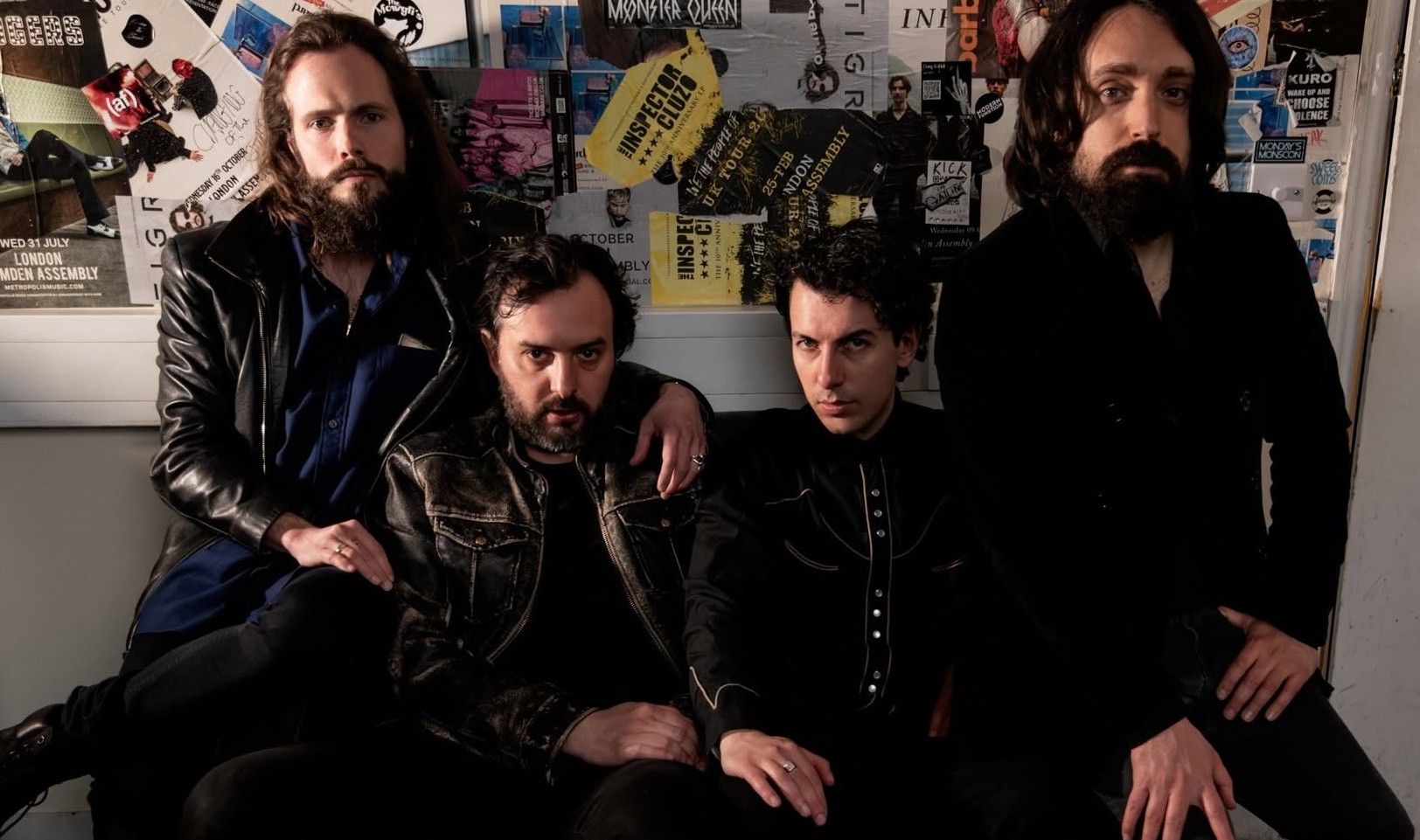
The Heat Inc. first came to my attention sometime around 2024 after their debut album Asleep in the Ejector Seat became a cult record and the band were garnering rave reviews for their live performances. The Heat Inc. are Jon Dodd, vocals – a singer who sounds like he comes from the lineage of Jim Morrison, Iggy Pop and Nick Cave with a soupçon of David Bowie. Then there is Marco Simoncelli on guitar, who has a dedicated talent to find riffs and rhythms which mark him out as like a young Keith Richards. Then add to this Nicolas Rigot on bass and Maurizio Vitale on drums are like the V8 engine at the heart of the band.
The Heat Inc. have been variously described as “Pure rock and roll” (Louder Than War); “Proper good” (Paul Simonon); and “one of the best and most blisteringly talented bands to emerge on the music scene in the past few years” (Dangerous Minds). This year they signed-up to Republic of Music and have recorded a new album which is due out later this year.
The new single Mind Control shows how The Heat Inc. have developed as a band, mixing their trademark rhythmic power with a haunting melody.
“Any number of bands can go heavy and there are a lot of bands out there that do easier numbers as a habit,” Dodd says. “But very few can do both in one evening and not seem like two totally different bands. There is a very succinct blend of heaviness with melody that we try to maintain at all times without thinking too hard about it.”
“We definitely understand one another better now. Stuff comes together faster and we have a pretty keen sense for what’s going to work before getting stuck in the weeds. We’ve always been okay with going for the gentle, melodic number, but now we can do that while still maintaining an intensity that doesn’t overthrow an otherwise beautiful song.”
Jon Dodd – Vocals Marco Simoncelli – Guitar Nico Rigot – Bass Maurizio Vitale – Drums
I first met Al Bell when he co-ran a graphics company from the top floor of the old Red Hackle building on Otago Street, Glasgow in the 1990s. The office was an open-plan attic space which from the outside looked like an upturned boat atop the building. The windows gave a vista onto Kelvinbridge and the glittering waters of the River Kelvin below. This grand old building had once been the warehouse for the famous Red Hackle whisky – once known as Scotland’s best whisky – but back then in the 1990s, it was home to a graphics company, Anita Manning‘s Great Western Auctions, and a carpet business along the ground floor. Next door was the Guru Nanak Sikh Temple.
This graphics company had built up a highly successful portfolio with a large number of A-list clients. Then one day, Bell quit and moved onto running a variety of personal projects and businesses which unlocked different parts of his many talents. This led Bell, by one way and another, back to his love of painting.
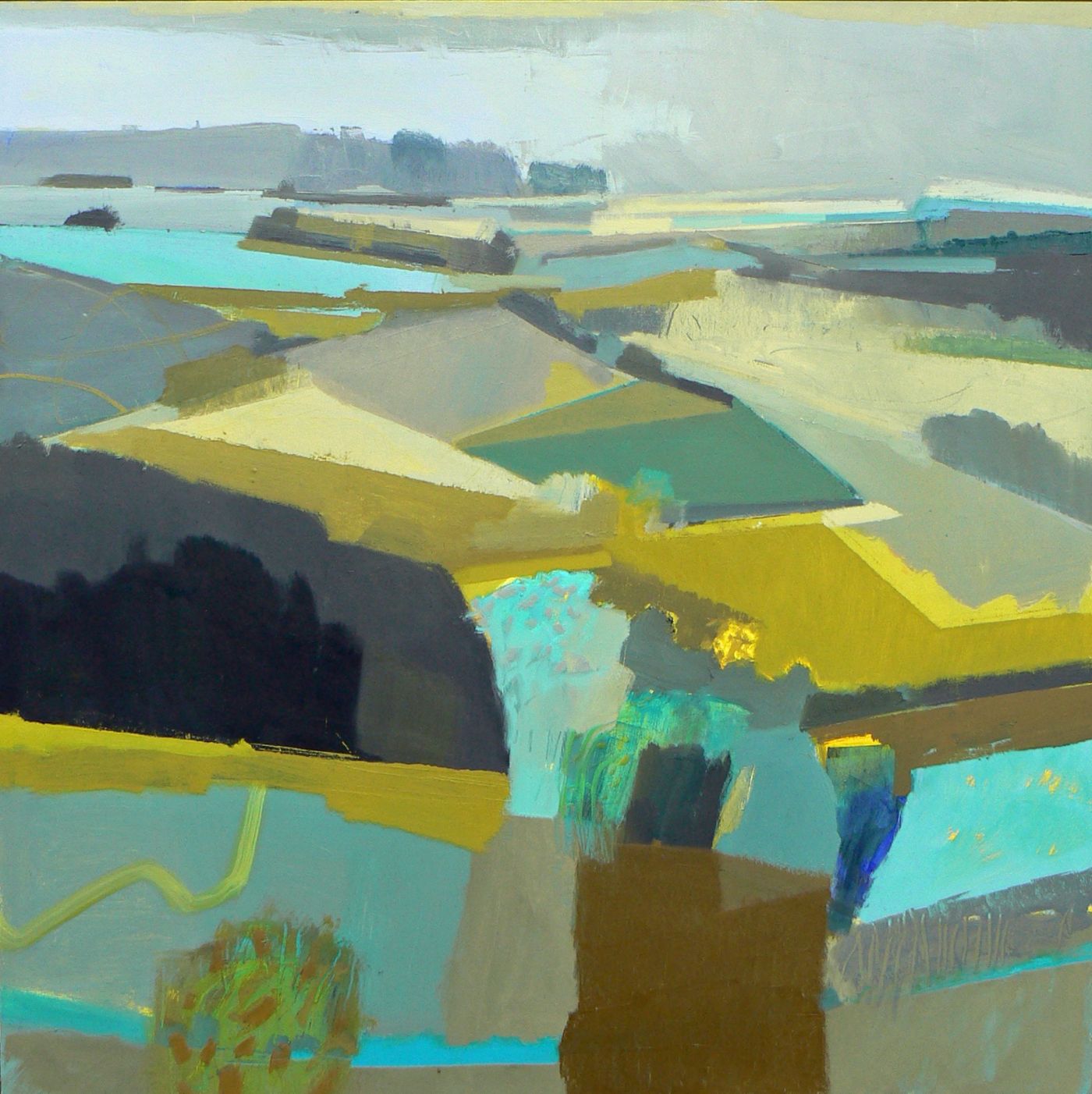
Al Bell is a landscape artist. He paints the Scottish countryside in all its beauty, strangeness, and glory. His work fulfils the idea of the landscape artist reflecting not just the beauty of nature but presenting the countryside as a reflection of the human experience.
“The artist should not only paint what he sees before him, but also what he sees within himself.”
This month, Bell has major solo exhibition Places at the Torrance Gallery in Edinburgh from 4th-25th July:
“Placesis a solo exhibition presenting semi-abstract landscapes inspired by the Scottish countryside. Moving along a fluid line between realism and abstraction, the works explore memory, atmosphere and the emotional resonance of familiar places.“
Tell me about yourselfand how you started painting?
Al Bell: I trained in graphic design in Glasgow and spent most of my career in the creative sector working mainly with art clients – theatre, music, dance and events. That was a joy and I loved getting involved with these energetic organisations, from small theatre groups to larger clients like the Glasgow Royal Concert Hall and Scottish Ballet. I designed all the first Celtic Connections materials, worked with Glasgow Jazz Festival, The BBC Scottish Symphony Orchestra and Centre For Contemporary Arts to name a few. This was a great cultural time for Glasgow with the city playing the roles of City of Culture and City of Architecture and Design and I was lucky enough to be right in the middle of it! After 2010 I evolved into game design and created landscape environments for computer games, designing digital assets inspired by nature. And now I paint landscape! In a way it all feels like a natural progression with common threads like composition, texture, shape and colour running through all these career phases. In graphic design it was my job to interpret my clients’ brief visually. I’m now in a position where the natural world around us is writing the brief and all I have to do is capture even just a tiny part of that pass it on in paintings.
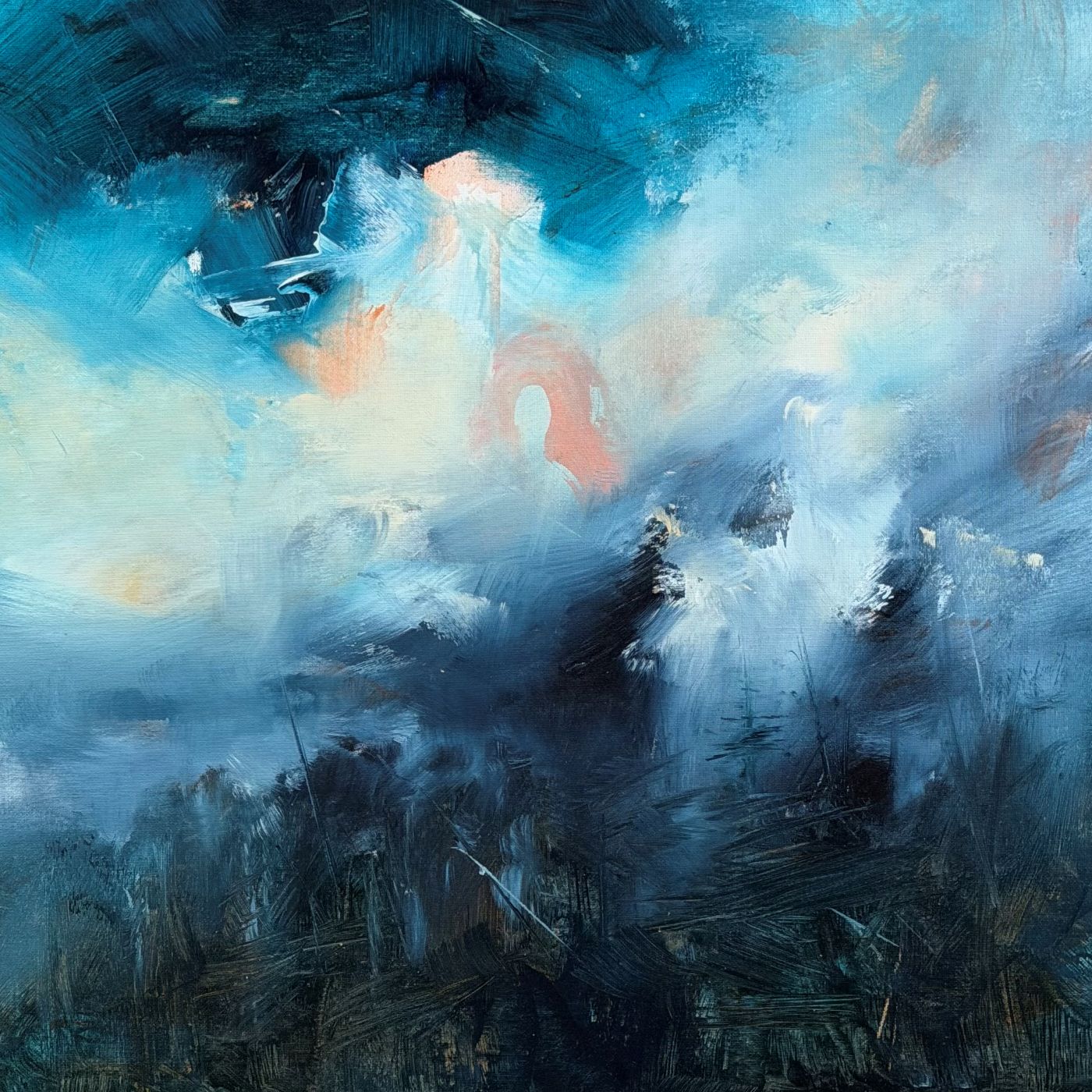
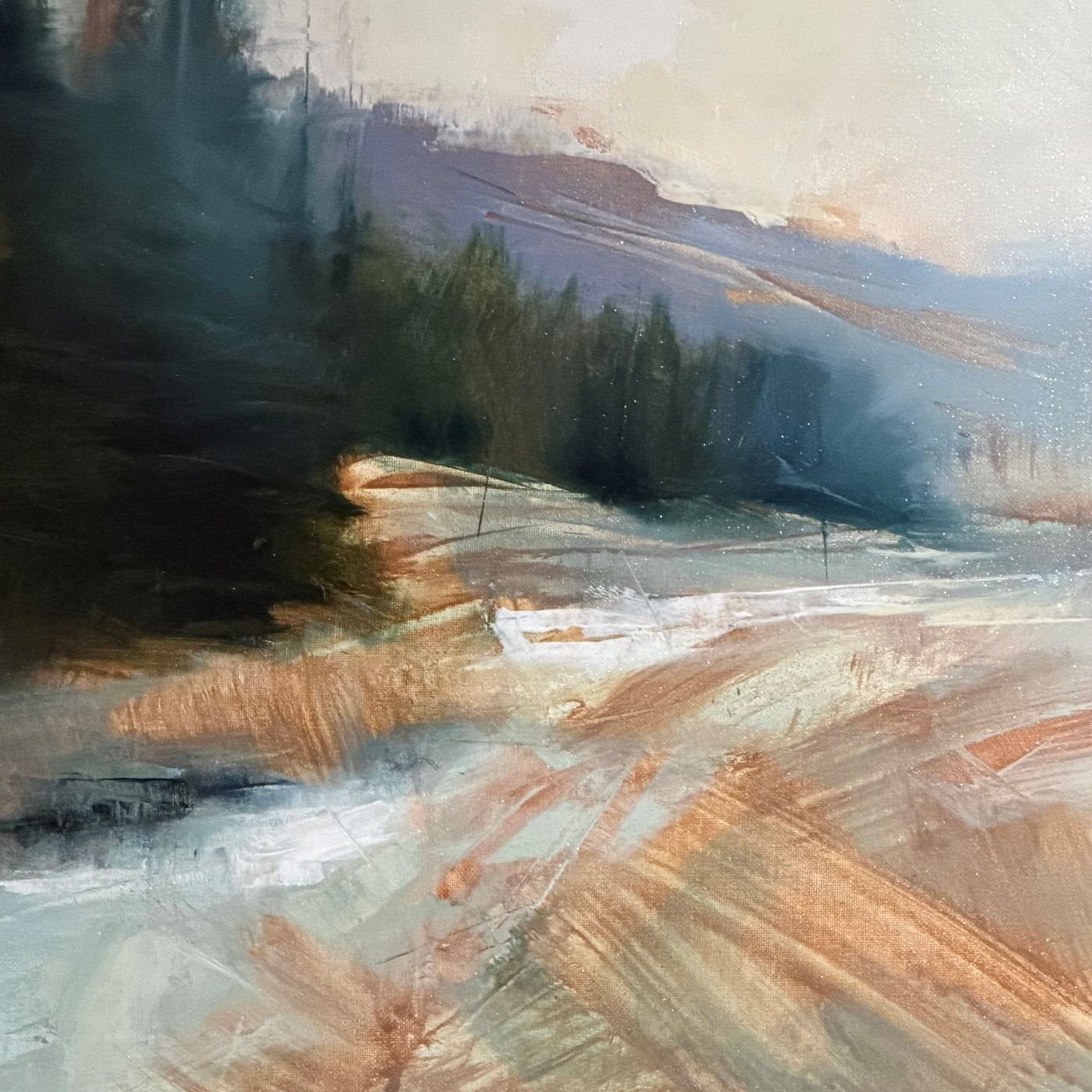
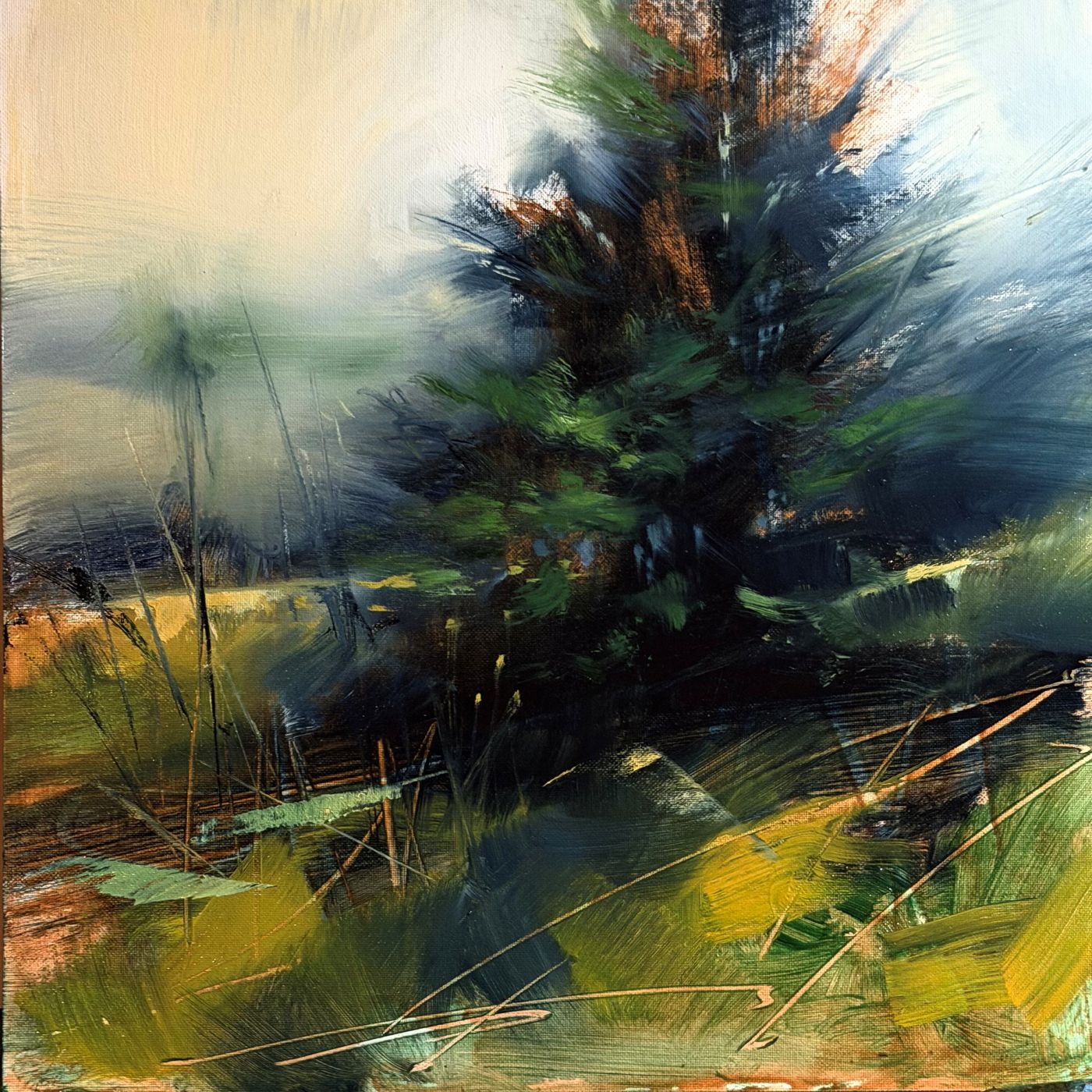
Always a Way.
When did you start painting?
AB: My father was an architect and painter who always had a watercolour on the go and loved to experiment with acrylic and oil. His subject matter was varied but landscape was his passion. When I was around eight years old he painted a large scene of footballers high on my bedroom wall – he was an inspiration. I drew and painted a little here and there throughout my life but, being busy with my design career, I always thought it would be something I’d take up seriously later on!
That time finally came around early 2021 and I set about a process of learning and developing my art practice. I first showed work in a gallery late 2021 and have been contributing to group shows since then. In late ’25 I was selected to take part in the Visual Arts Scotland Biennial show at RSA in Edinburgh. That was a real honour and inspiration to be part of a national exhibition alongside such creative talent.
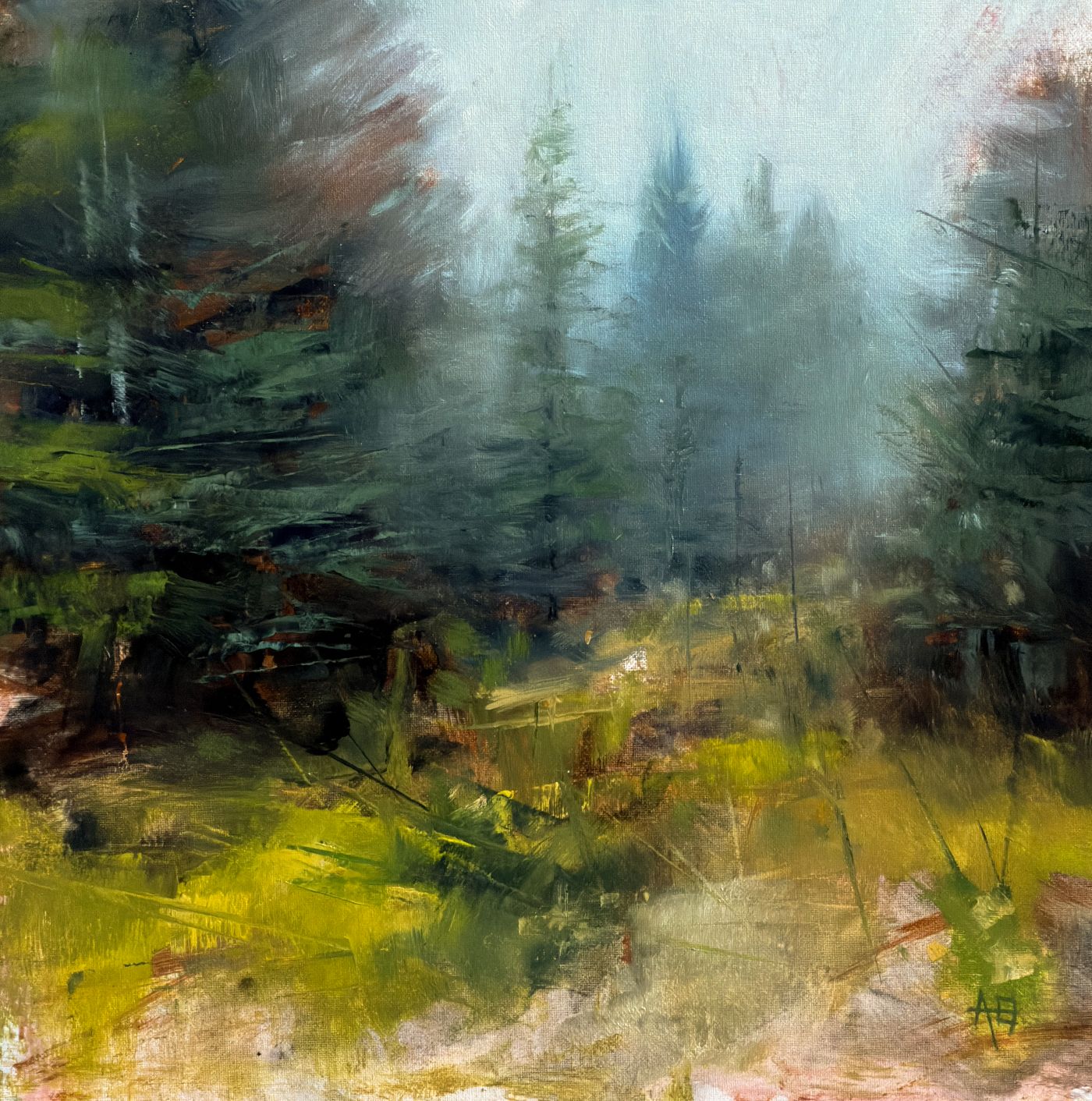
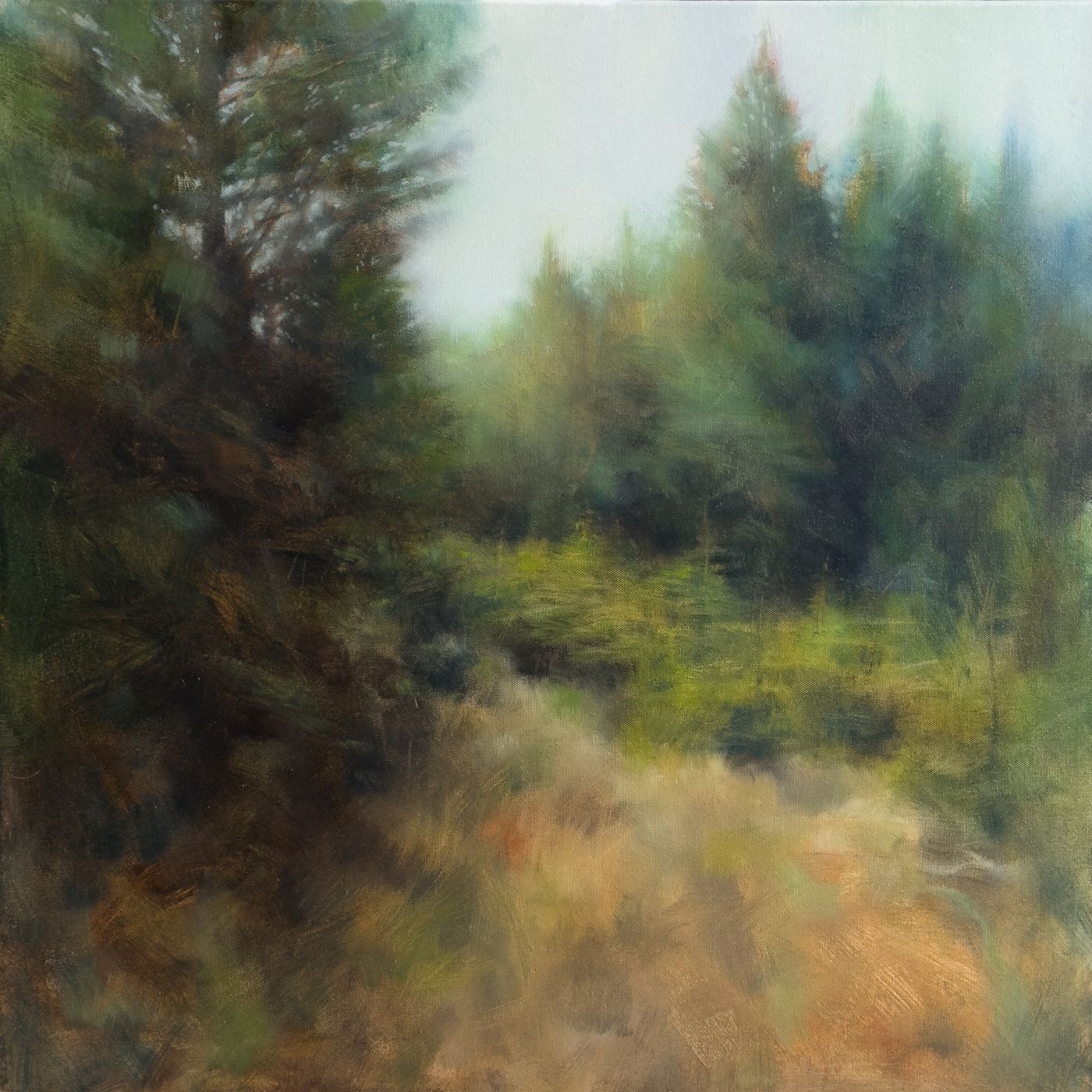
Forest.
What attracts you to landscapes and how do you paint?
AB: I’m obsessed with the detail of landscape. I love quiet corners that, while not usually recognisable vistas, still resonate with viewers who have the sense that they have been to and enjoyed that exact spot. In a way, I’m trying to paint the idea of a place rather than replicating a particular scene. I find that is a powerful way to get closer to my goal of connecting to the viewer.
I tend to use quite abstract brushwork or loose palette knife shapes to quickly build up areas of dark and light, textural gestures that are not detailed on close inspection but when viewed as a whole, have an engaging sense of realism. I simply love the marks a paint brush makes on canvas and always aim to leave as much raw brushwork as I can! I like to see the energy of the artists movements in a painting and I aim to do this in my own work.
I’m also very keen on dynamic composition, where the viewer is led into the painting through subtle vectors, directional marks and atmospheric perspective. I consider myself to be a fairly technical painter but my aim is always to convey emotion and atmosphere.
I’m constantly enthralled with the beauty of the natural world, the colour, textures, shapes and moods. I love observing and travelling through the landscape, being immersed in it all, so I’m naturally drawn to the idea of representing what I see on canvas. I particularly enjoy taking a scene that may not at first seem to be the “headline act” but rather something less obvious and find a way to express the beauty of it in paint. Very often this might be an old forest path inviting the viewer to turn a corner out of site, to discover a way beyond. Or it might be the still surface of a river, capturing the reflection of the trees above with the tiniest hint of light reflecting on ripples. Sometimes it’s simply the edge of woodland. And clouds, well they write their own rules I just try to follow! This may make me sound like I’m a bit of an old romantic but to me this beauty is essential to help us navigate our way through life and I simply try to interpret these notions as understated but engaging paintings.
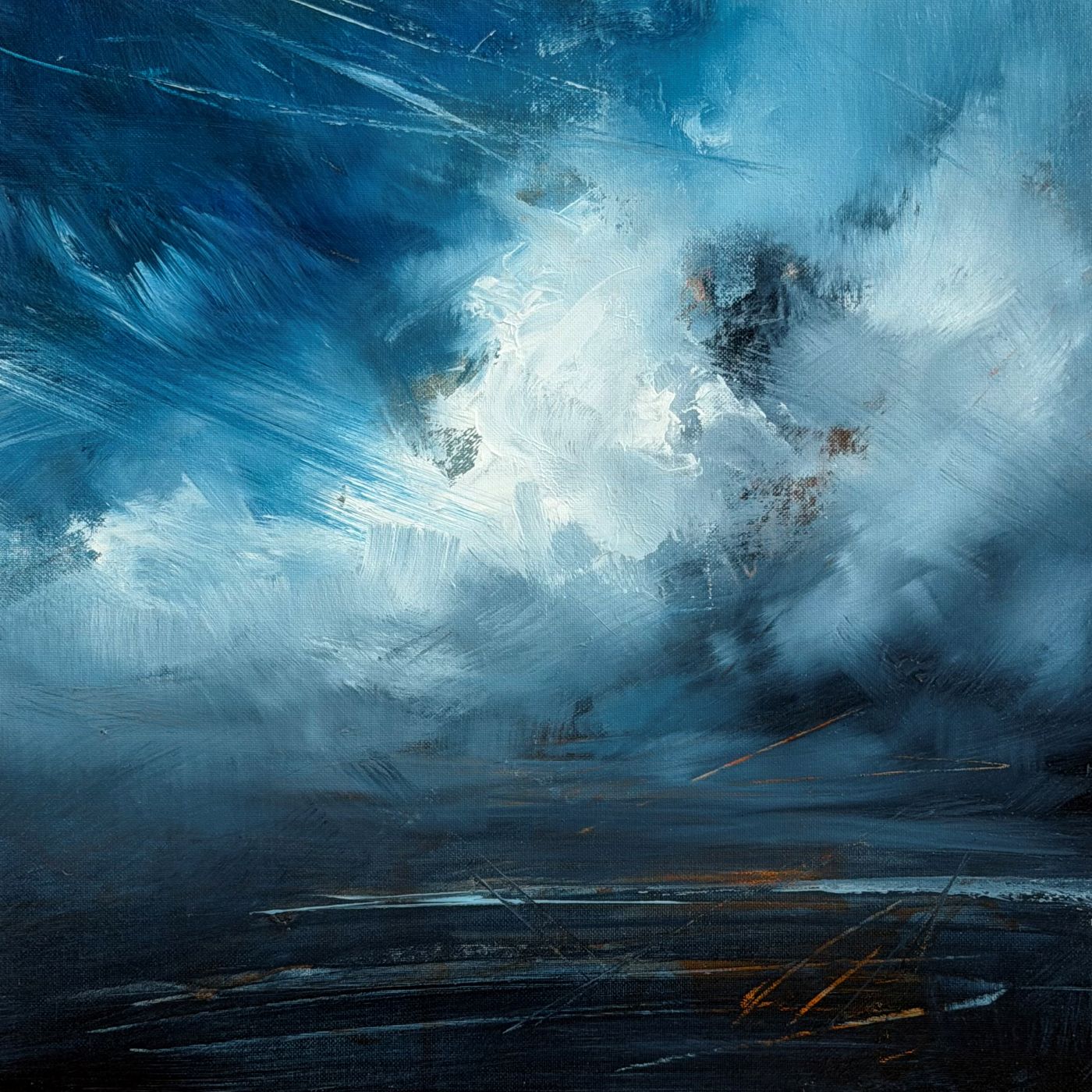
I Dream of Clouds.
Which artists influence you? Who do you like and why?
AB: I’m drawn to landscape artists who totally understand realism but express their work in a fluid, abstract or graphic way. It’s their technical skill and seemingly effortless freedom of process that I enjoy as well as their ability to create the sublime from every day scenes.
20th Century figures like Andrew Wyeth and Richard Schmid are high on my list of inspirations as well as painters like Tom Thomson. I’m also a huge fan of Scottish artist, James Morrison. His use of transparent colour, his immaculate draftsmanship and his depiction of incidental detail and sweeping skies – all contributed to my desire to paint landscape.
Also, there is a wealth of highly talented painters currently working that are a huge source of inspiration. Painters like Tibor Nagy, David Lidbetter or Vladimir Kirillov are all good examples. But just seeing any amazing art on Instagram is enough to set me off!
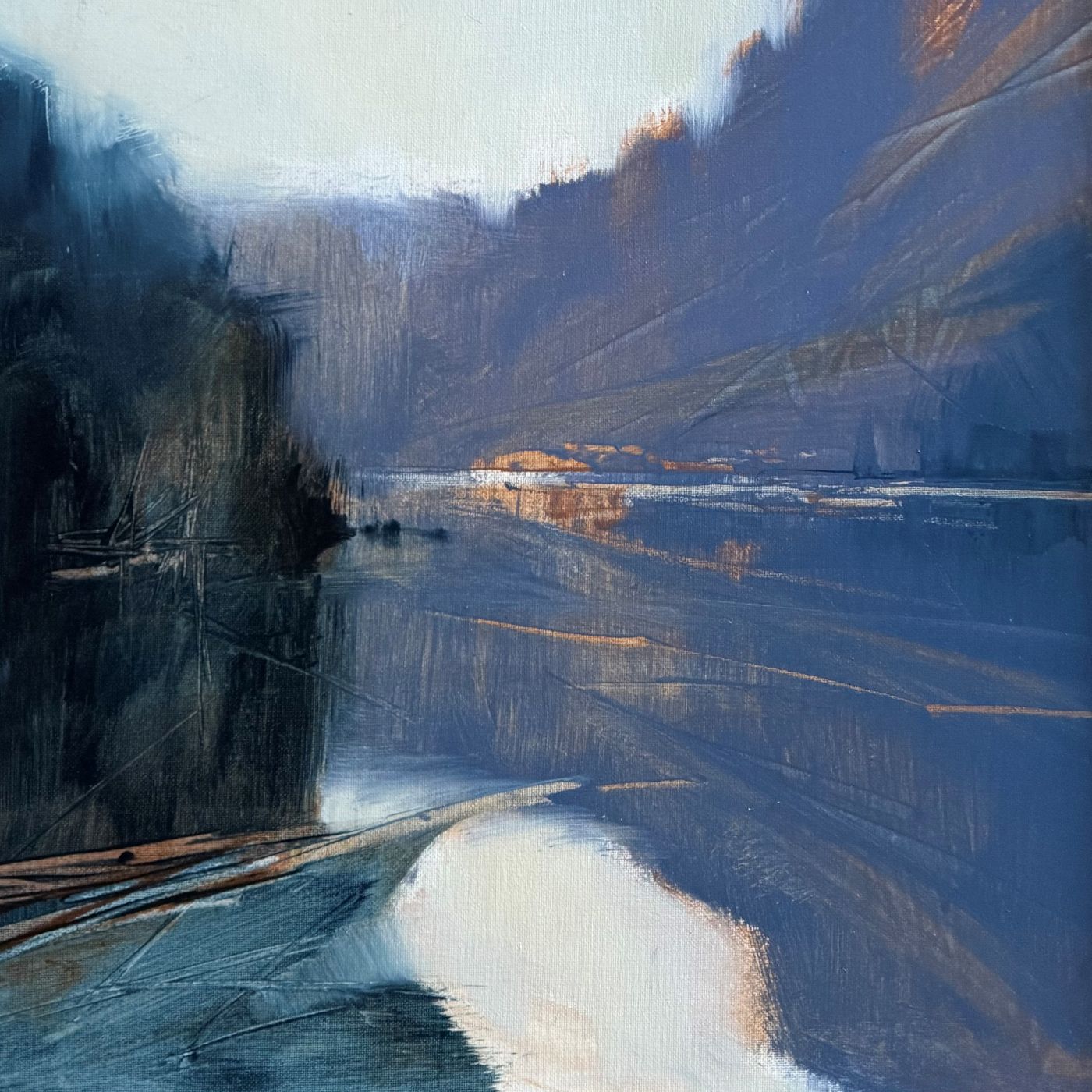
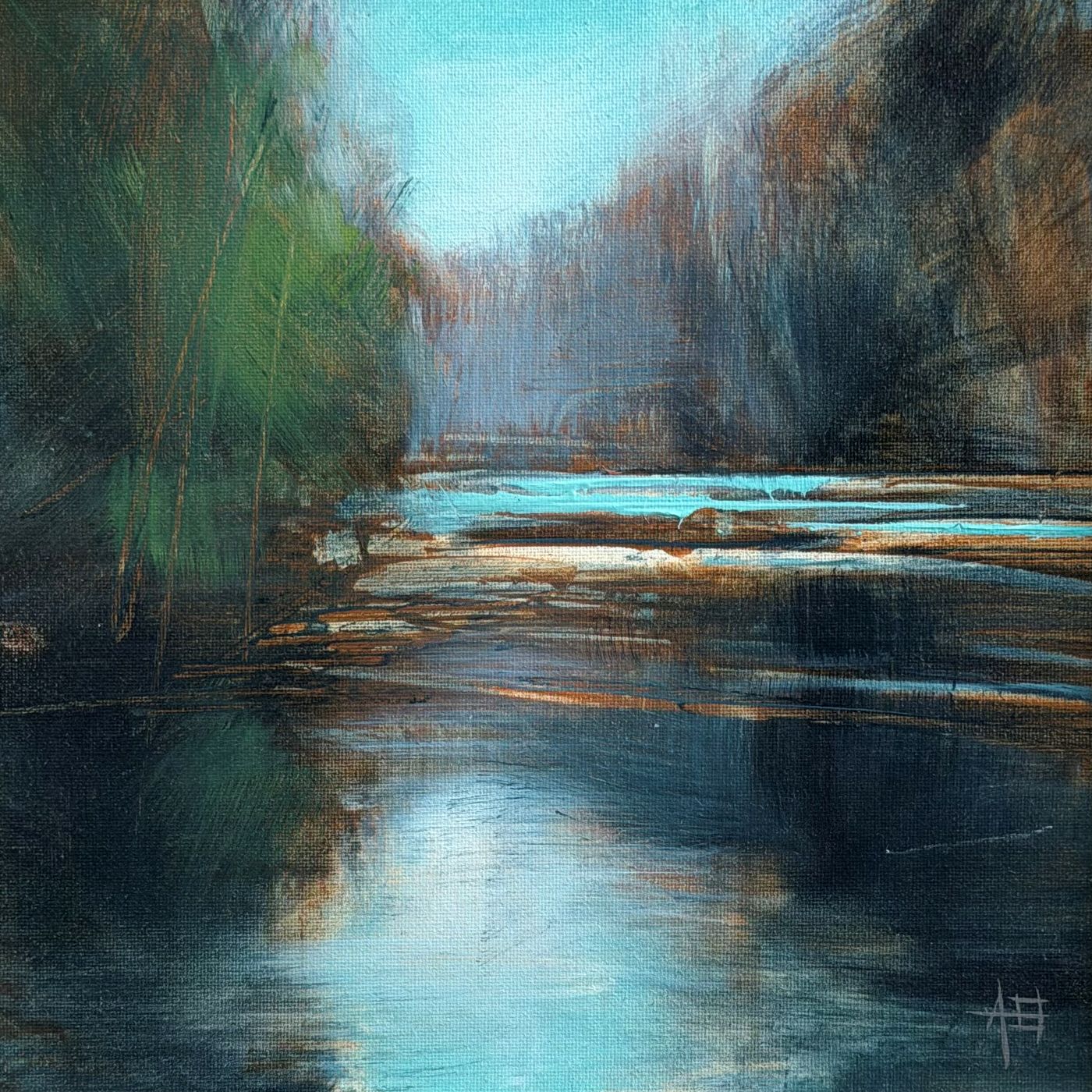
Low Water.
Tell me about your forthcoming exhibition?
AB: Places will be my first solo show and reflects a range of subjects and locations I love to visit and to paint – from deep moody forest to wild coastal cloudscapes. I often explore forgotten forest paths or overgrown riverside, usually while dog walking or cycling, and such places are my starting point. Although these scenes can be quite diverse, I’m aiming to bring them together as a story of my deep appreciation of landscape and my joy of painting.
There is a flow of technique that responds and adapts to the various subjects, forms and shapes I see. I hope the uniting factor in the collection is in the way I perceive and interpret the beauty that surrounds us in nature.
I’m particularly interested in play of light, where dark corners meet incoming rays, sunlight through trees, sky reflected in water or the contrast of deep soft shadow against bright skies. There is drama in this.
I like to explore my subjects using techniques somewhere between realism and abstraction – playing on a sliding scale between those ideals but always with as minimal a suggestion of detail as I can manage. I’m not really interested in literal representation but aiming to leave something to the viewer’s imagination, to capture the mood and atmosphere of a place that connects people to their own memories. My hope is that they are drawn into my representation of the landscape and get lost in that place. I find that when that moment of recognition happens people really relate strongly to the works. It’s incredibly rewarding to be able to represent memory of place in that way.
So all these thoughts have gone into the show. I hope the collection brings a little joy and excitement to people with a love of landscape and an appreciation of paint on canvas.
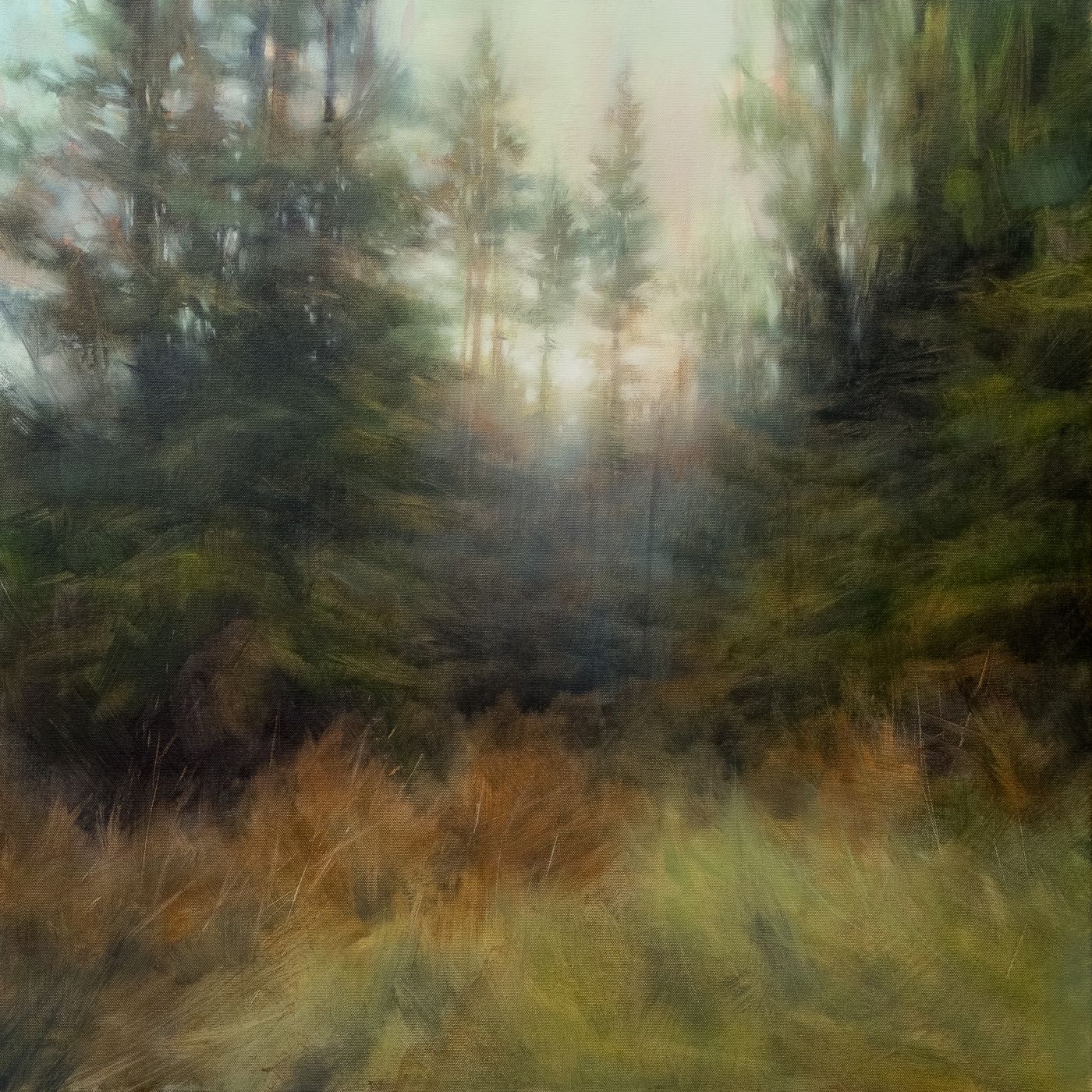
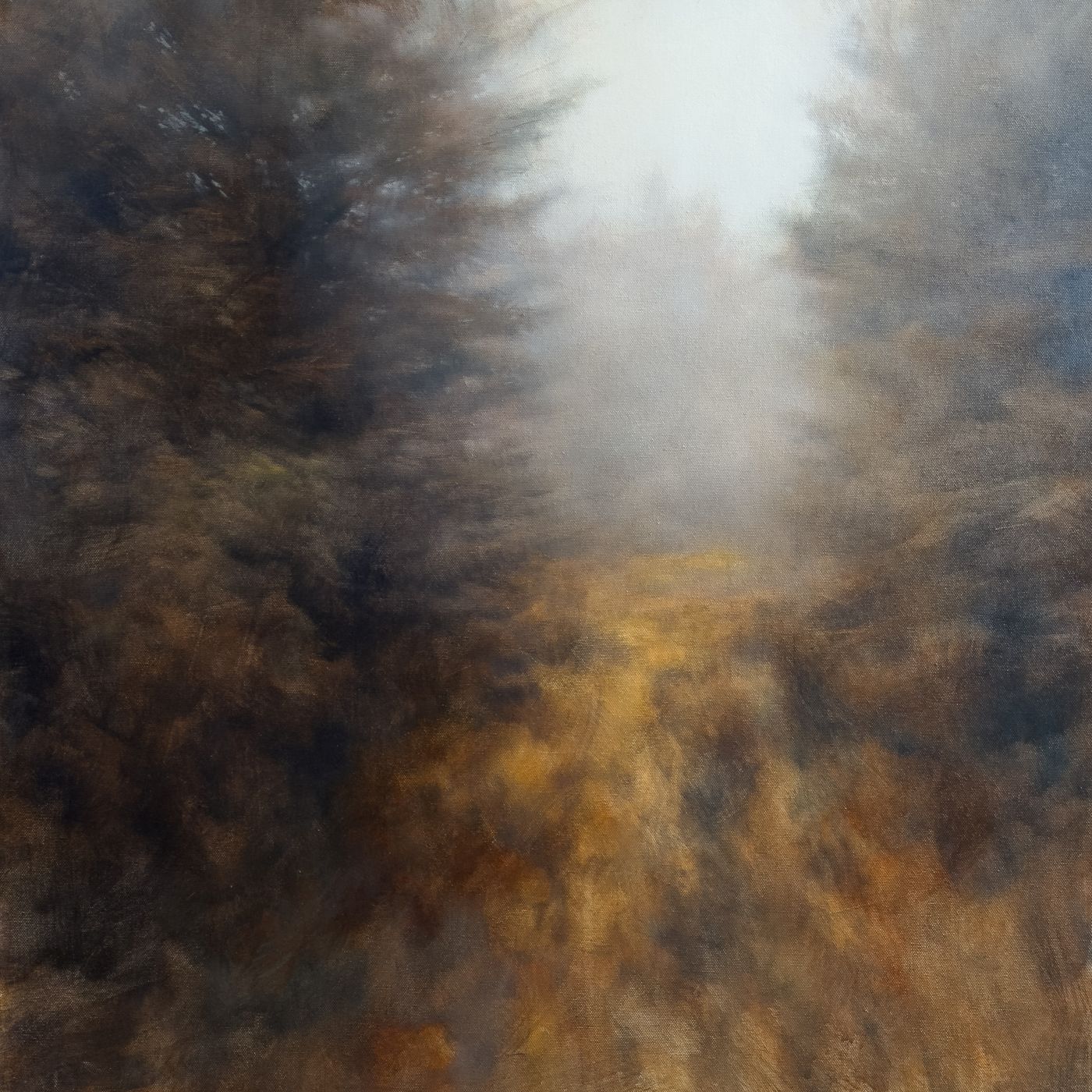
New Growth.The Gateway.Where Earth Meets the Sky.Where Hills Sleep.Wild Mountain Pine.
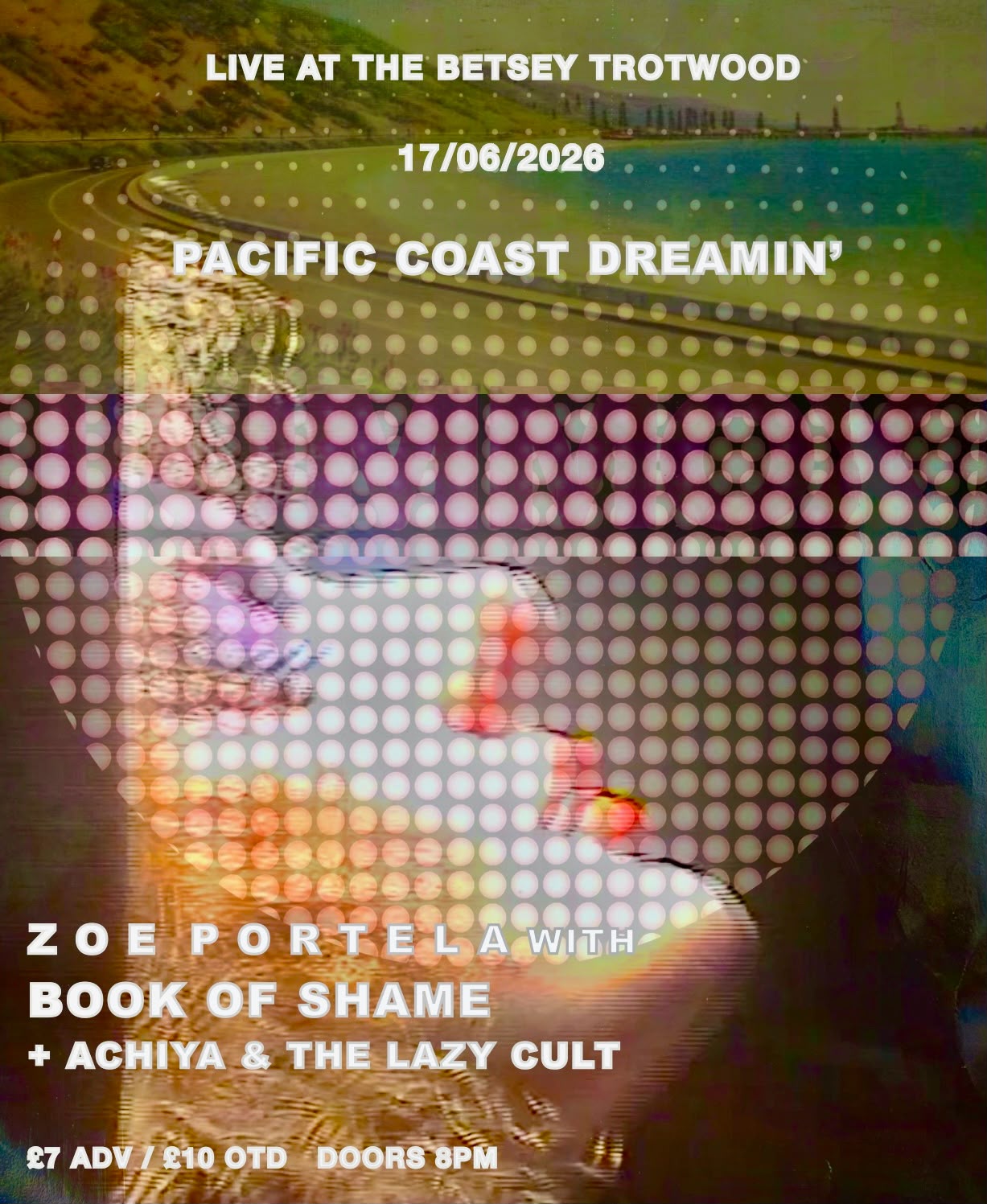
For you young bohemian rebels who hanker after something better than the endless late-night doomscroll of World Cup football, then why not enjoy an evening of Pacific Coast Dreamin’ at the Betsey Trotwood in Farringdon, London, tonight at eight o’clock 17th June.
For seven quid in advance or a tenner on the door, you can thrill to “a dramatic feast of indie psychedelic rock” from Zoe Portela and Book of Shame, followed by a blend of hip-hop and punk from Achiya and The Lazy Cult.
Book of Shame is the rather compelling twinset of one Duver Brother video artist and director Peter Boyd Maclean and the multi-talented, multi-instrumentalist brilliance of Gary Bridgewood. Having formed a Holy Trinity with singer, performer, and dazzling original talent Zoe Portela, the trio look set to kick out all the jams tonight.
What are you gonna do when you’re on the back slice of life wondering where the fuck your dreams have all gone? Are you still going be there waiting in line at fifty or sixty, the rain running down your neck wondering what you could have been if you’d had just a little more faith? Had a little more desire to change and be the very one thing you always wanted to be?
Peter Boyd Maclean took that chance. He quit his stellar career as a London-based filmmaker and award-winning TV documentary director and formed a band called Book of Shame. Boyd seemed to have it all but he wanted something more, something real, something to call his own. He teamed-up with multi-instrumentalist Gary Bridgewood from Troubadour Rose. Over a two-year period the pair jammed, rehearsed and laid down tracks for their debut album (out this month) with a little help from singers Jo Foster and Claire Nicholson, percussionist Fergus Gerrand, pedal steel BJ Cole, and renowned record producer (Wire, Depeche Mode, Swans, Laibach, and St. Etienne) Rico Conning.
With a handful of singles already released, Book of Shame has earned comparisons to Captain Beefheart, the Velvet Underground, Joy Division, Radiohead, and even Alice Cooper. Boyd Maclean’s life-so-far and the beginnings of Book of Shame read like a once-upon-a-time in a land not so very far from here tale full secrets, a bad step-parent, fortuitous meetings and a helluva lot of talent.
I digress.
Zoe Portela is well-known as an incredible chanteuse with highlights including shows such as Phrygian Tag: Songs For Sanity and Phrygian Blues. Portela will sing two David Bowie songs on a forthcoming compilation album featuring just vocals and piano. Producing and tinkling the ivories perfectly is Clifford Slapper. Other contributors to this album are Sophie Ellis-Bextor and Emma Thomspon.
Tonight at the Betsey Trotwood be inspired and thrilled by the mind-blowing talents of Zoe Portela, Book of Shame (who will also be joined by the other Duvet Brother Rik Lander on bass) together with Achiya and The Lazy Cult in an evening of Pacific Coast Dreamin’. 8pm the Betsey Trotwood, 56 Farringdon Road, London.
‘Light at the End’ – Book of Shame with Zoe Portela
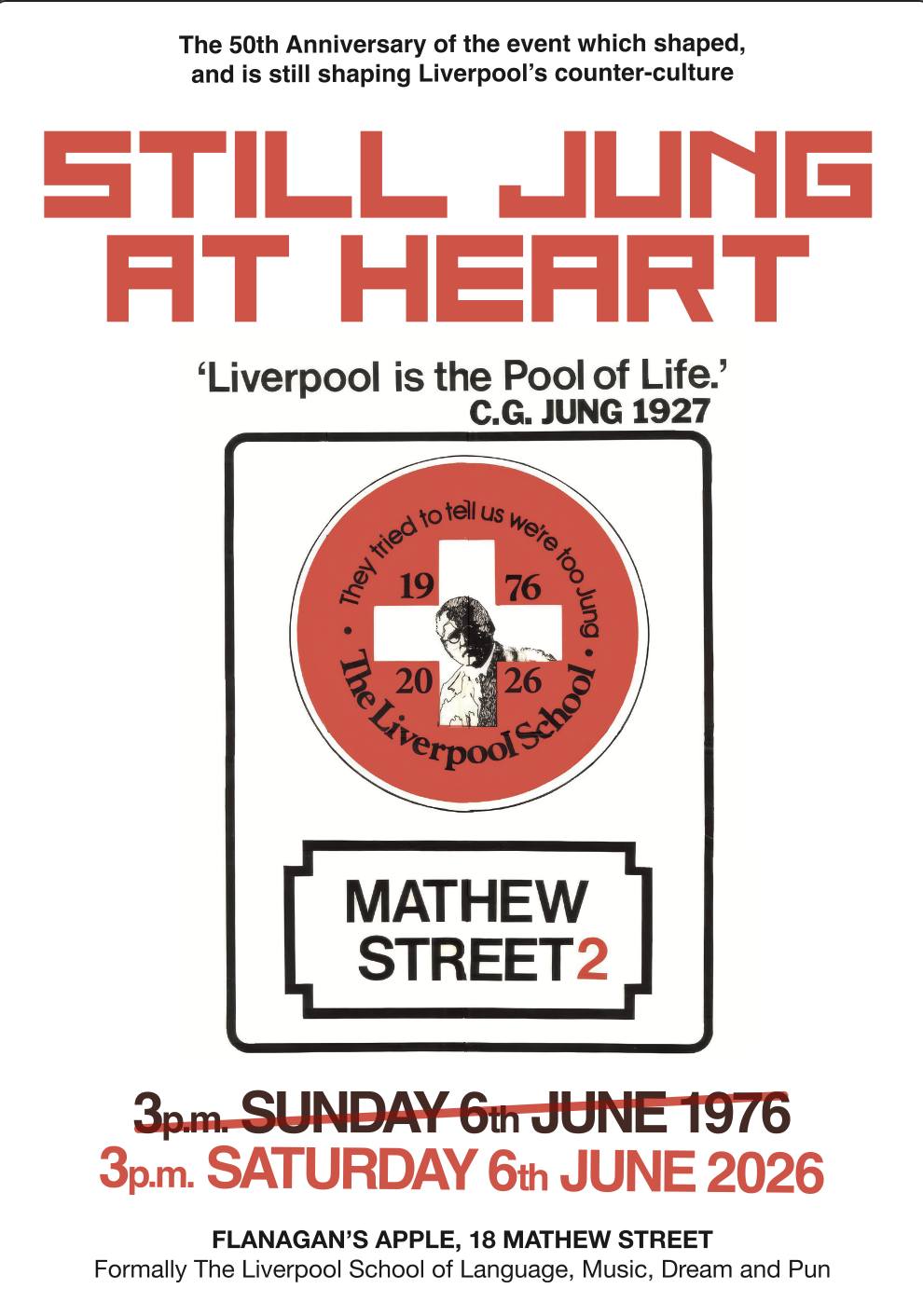
A guest blog from writer, director, filmmaker and all round good guy Grant McPhee on ‘Still Jung at Heart’ an event this Saturday 6th June celebrating the 50th anniversary of the Jung Festival in Liverpool which unleashed a creative shift in the city arts and music scene.
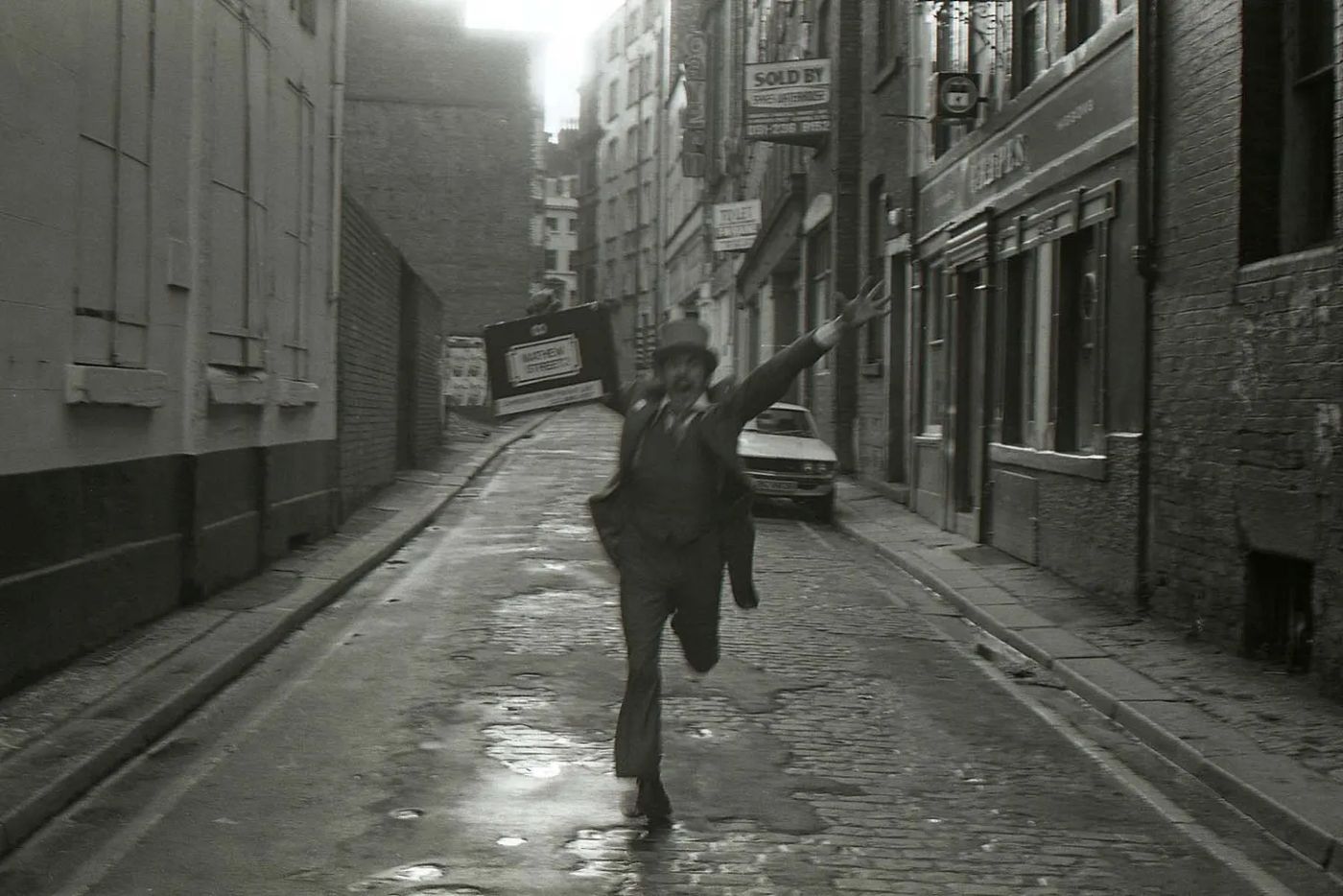
On Sunday the 6th of June 1976, a cultural event took place on the then dilapidated and largely forgotten Mathew Street, one that has almost disappeared from Liverpool’s collective memory. Yet its impact on the city would prove every bit as significant as The Beatles’ time in that same back-alley.
It was the First Jung Festival, and it was held at The Liverpool School of Language, Music, Dream and Pun, a former fruit warehouse that had become a DIY arts hub. Over the previous two years, the building had evolved into a meeting place for Liverpool’s bohemian underground, attracting artists, musicians, writers, performers and young outsiders searching for something beyond the city’s prevailing sense of decline.
At the time, the original Cavern, a few doors down, had already been bulldozed, and its replacement was itself also in terminal decline, while Eric’s, the venue that would soon become synonymous with Liverpool’s post-punk explosion, was still months away from opening. Liverpool was suffering economically and culturally yet on this street, most associated with the city’s past triumphs, something entirely new was about to emerge that would birth something entirely different and entirely strange.
The driving force behind the building and festival was Peter O’Halligan, whose belief was that Liverpool could be revitalised through culture, music and the rebirth of Mathew Street itself. That vision found an unlikely focal point in the work of Swiss psychologist Carl Gustav Jung and a festival to celebrate a 1927 dream he had of the city, one which he described Liverpool as The Pool of Life.
Liverpool is the pool of life – Carl Jung.
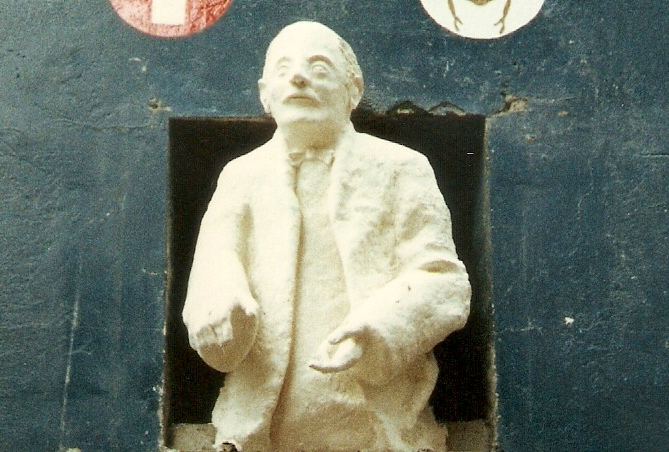
The centre-piece of the festival would not just include music but the unveiling of a Jung bust and a ‘Pool of Life’ inscribed stone, which had recently been brought back by ‘The School’ from Jung’s home in Switzerland; while Jung’s grandson Marc Baumann also travelled to attend.
Fifty years later the whole thing can sound wonderfully eccentric. A group of artists, dreamers, musicians and outsiders gathering in a former fruit warehouse on a decaying Liverpool street to celebrate a Swiss psychoanalyst is not the obvious starting point for a cultural revolution.
Yet beneath the apparent absurdity was a serious proposition. O’Halligan and those around him believed the city had lost confidence in itself and could rediscover its identity through creativity, imagination, music and collective action. The Jung Festival was a statement of intent, grounded in synchronicity, Jung’s belief that sometimes coincidences carried a deeper meaning. This was done with a veneer of humour and surrealism on the surface, but it was merely an entry point, allowing something that was identifiable to many to offer a route for something deeper, profound and mysterious to enter through the subconscious. It was punk-rock’s twin sister, an alternative to its yin and yang. Something was timely.
The Sex Pistols had played Manchester’s Lesser Free Trade Hall on the 4th June, 1976, two days previously. That performance has become one of the most celebrated events in British music history, credited with inspiring a generation of musicians and helping to shape Manchester’s future cultural identity.
The Jung festival was what Liverpool offered. The differences were obvious. Manchester’s catalyst emerged from punk’s confrontation and nihilism. Liverpool’s came through art, mischief, surrealism, psychology and a uniquely local strain of creative eccentricity. It was a unique mixture of pranksters, dreamers, artists and visionaries, yet it was united by O’Halligan’s belief that culture could transform a city.
‘Still Jung at Heart’ – Flanagan’s Apple, Mathew Street, 3pm June 6th.
Almost all of the figures who would shape Liverpool’s future were either present at the festival that day. Bill Drummond was there. Jayne Casey was there. Ambrose Reynolds was there. Pete Burns was there. Holly Johnson was there. Paul Simpson was there. Paul Rutherford was there. Roger Eagle was there. What would later become Liverpool’s post-punk, independent music and alternative arts explosion was already beginning to gather in this one place and it’s no coincidence that what they later achieved share this one locus.
Within months, Eric’s had opened across the road. Probe Records relocated to a street nearby. Ken Campbell brought his legendary production of Illuminatus! to Mathew Street, with sets designed by Bill Drummond. New bands emerged, new ideas circulated and a new generation found its voice and their beginnings, arguably can collectively be pinpointed to this festival.
Much of Liverpool’s more famous post-punk mythology understandably centres on Eric’s, particularly The Clash’s appearance on the 5th of May 1977, when many of those who met each other for the first time that evening would soon be inspired to form Wah!, Echo and the Bunnymen and The Teardrop Explodes. Those stories have become part of the city’s cultural musical folklore. Yet by the time they occurred the important foundations had already been laid – at the Jung festival.
Fifty years later, that legacy deserves recognition. The festival may never enter popular mythology in the same way as Manchester’s famous punk moment, but its influence can still be traced through Liverpool’s independent culture, music, art and creative self-belief. On that day on the 6th of June 1976, Mathew Street came back to life and from that moment onward, Liverpool began to imagine, and reimagine, itself differently.
***
With thanks to Grant McPhee.
‘Still Jung at Heart’ takes place this Saturday 6th June at Flanagan’s Apple, 18 Mathew Street, Liverpool. Kick off 3pm.
Way, way back, many centuries ago…when I first worked as a director in TV there was a saying often bandied about by film crews when anything went wrong on a shoot: ‘Don’t worry, you can always fix it in the edit.’ This may have a different meaning now but back then it meant if you had an excess of unwieldy footage it could be whittled down into the most succinct of content by the editor. If an interviewee continuously ummed or ahed their way through an interminably meandering interview your editor could sharpen their words into the most pertinent of answers.
A good editor can make average content good and good content brilliant.
The best editing is not a craft, it is an art form. You never notice the best editing because it flows seamlessly like a piece of beautiful music.
The best editing makes the audience focus solely on the story being told.
Angela Slaven is one of the very best film and television editors working today.
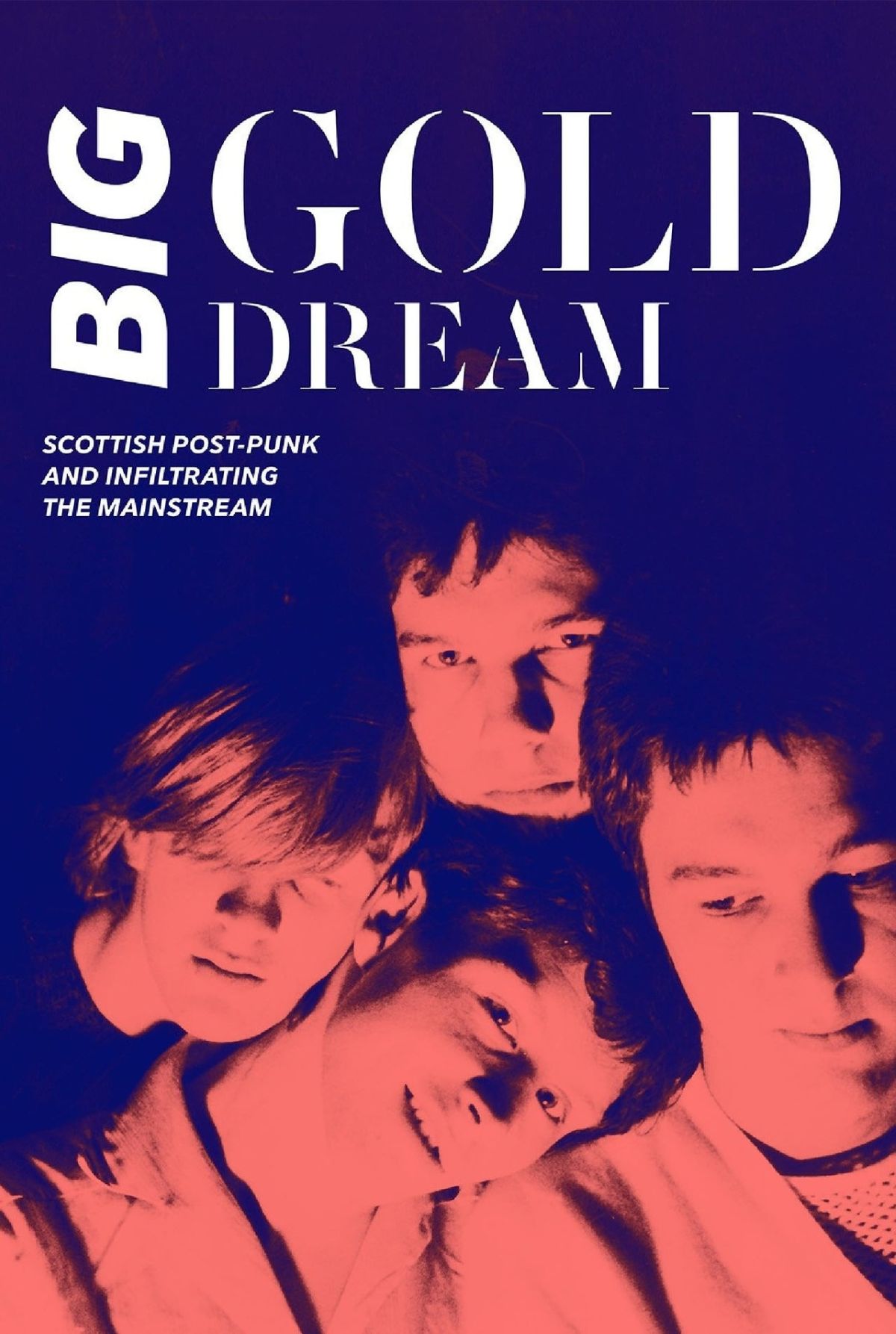
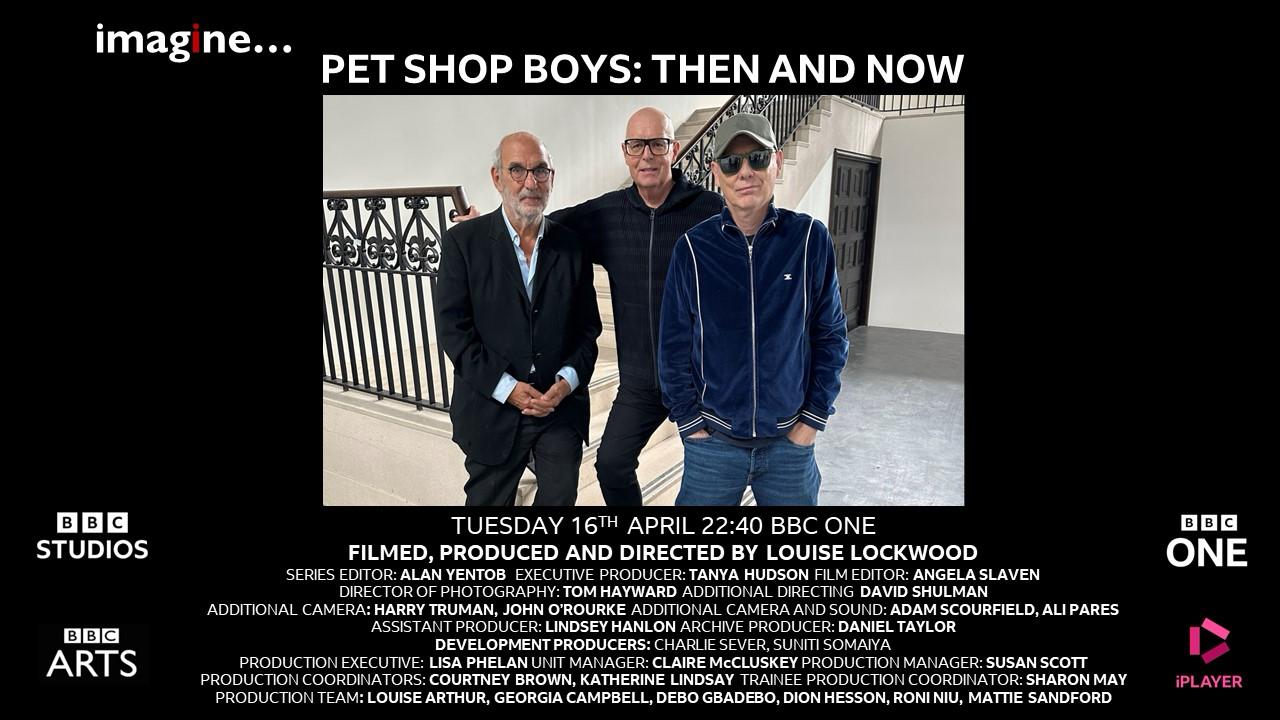
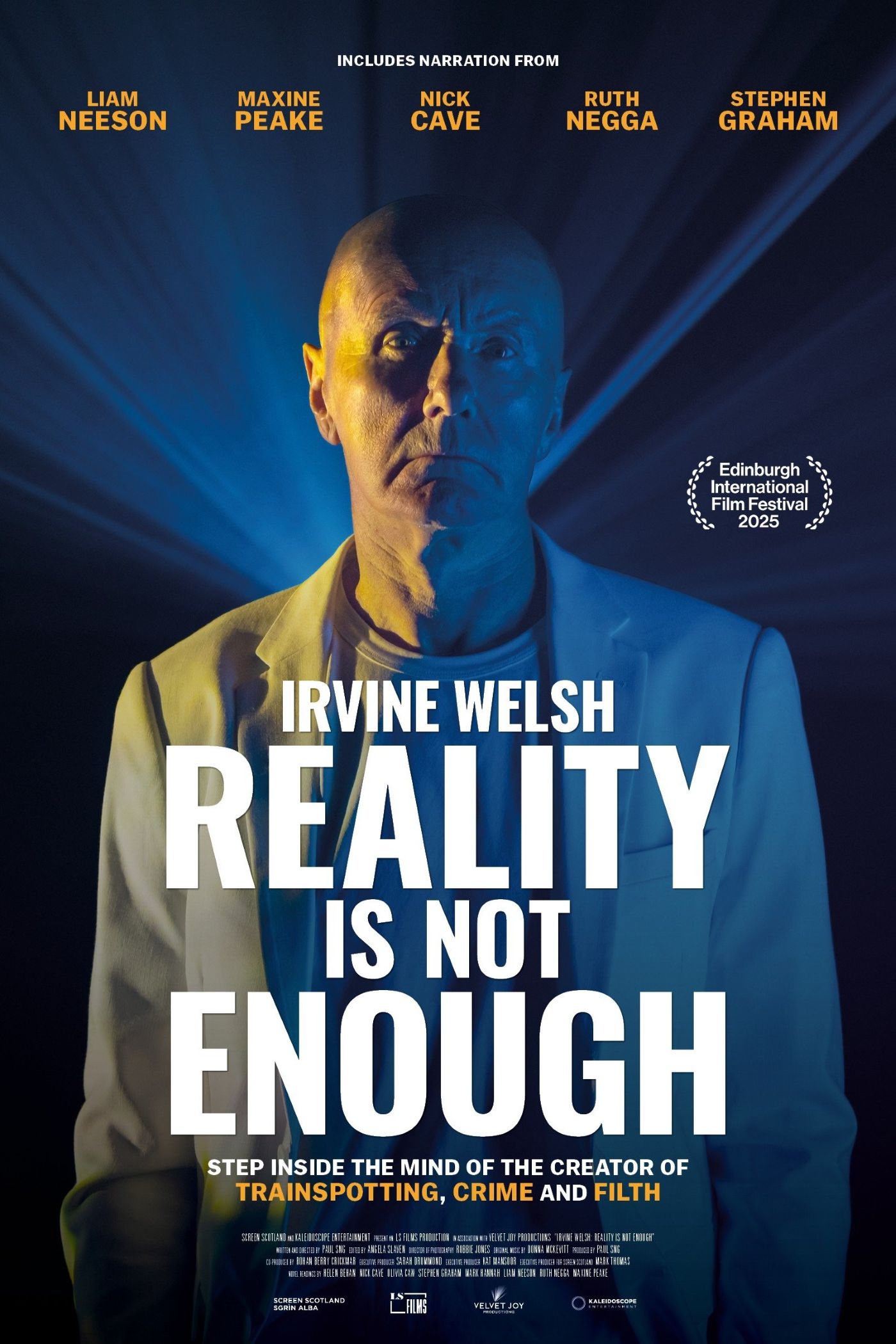
Born in Glasgow, Slaven started her career working in the Mail Room at Scottish Television. From such a seemingly unpromising beginning, Slaven made the move into post-production as an Assistant Editor where she learnt her craft and soon proved her unique talents as an editor. This led to Slaven cutting highly successful series like Taggart, High Times and Skint. Then moving into documentaries editing Michael Prince’s film on author John Irving and then his superb film on photographer Brian Griffin before working on Grant McPhee’s award winning documentary films Big Gold Dream and Teenage Superstars which focussed on Scotland’s post-Punk music scene. More recently Slaven has edited films on the Pet Shop Boys, Ivor Cutler and worked with Paul Sng editing in conjunction with Lindsay Watson his documentary on photographer Tish Murtha and cutting his film Irvine Welsh: Reality is Not Enough.
Tell me about your background.
Angela Slaven: I grew up as an only child in Glasgow, in Yoker on the boundary with Clydebank, and came from a railway family. The prevailing soundtrack was Mantovani and the Spanish and Italian eps my parents had bought on their holidays, journeying around Europe courtesy of their discounted railway passes.
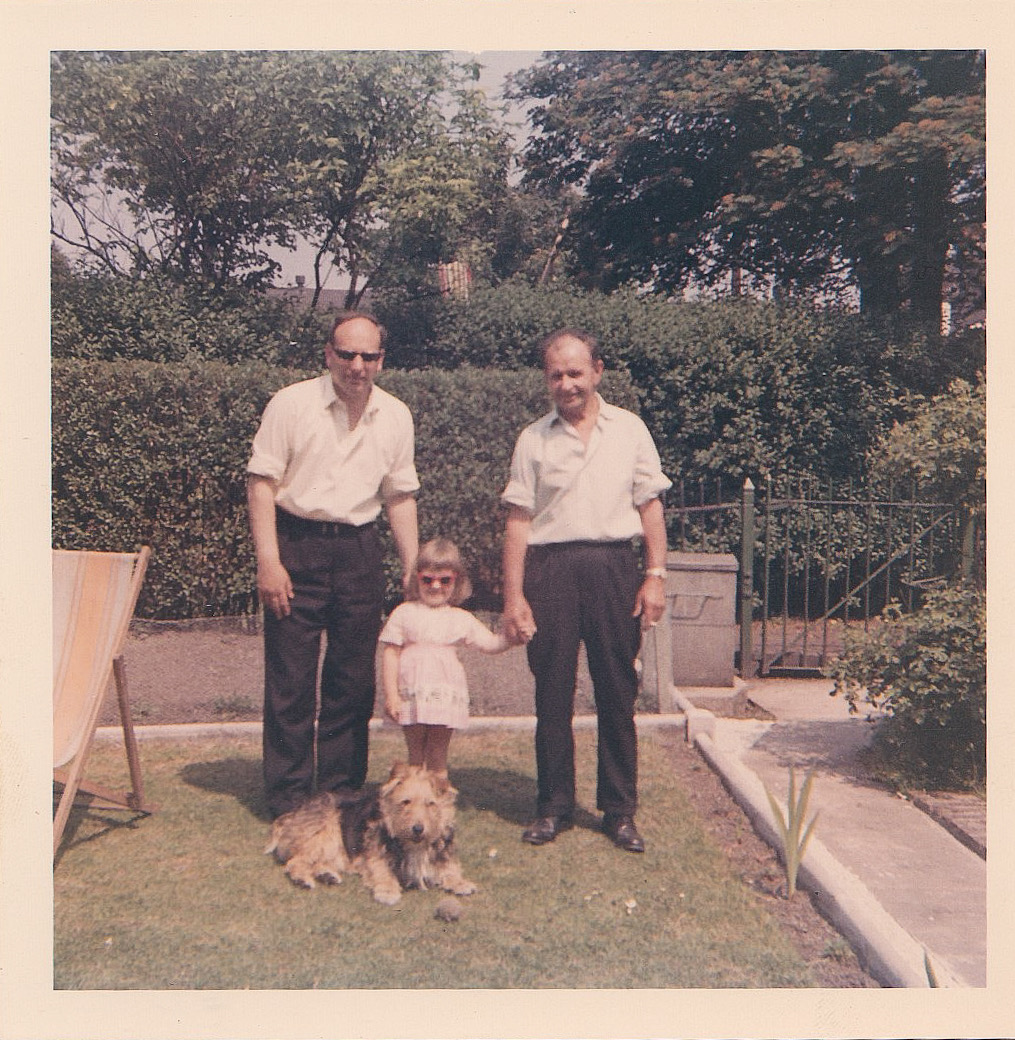
Angela Slaven with her father Jimmy Slaven, grandfather ‘Papa’ James Smith and Bobby the dog.
AS: I was a bit of a tomboy, loved trainsets and cars and always had my nose in a book. Although my mum had to give up work when I came along, she would sometimes take part-time jobs, for example in Lewis’s at Christmas (therefore she knew the real Santa, not the fake Goldbergs or Frasers ones!). When she and my Dad were working, my Papa who lived close by in Clydebank would take me over to the Clydeside with Bobby the next door dog, where we’d play football on the old railway lines at the Rothesay Dock in the shadow of Yoker power station, stash the ball under an old railway sleeper then have a milky coffee and a buttered roll with chocolate buttons at the local café Pelosi’s near the Renfrew Ferry.
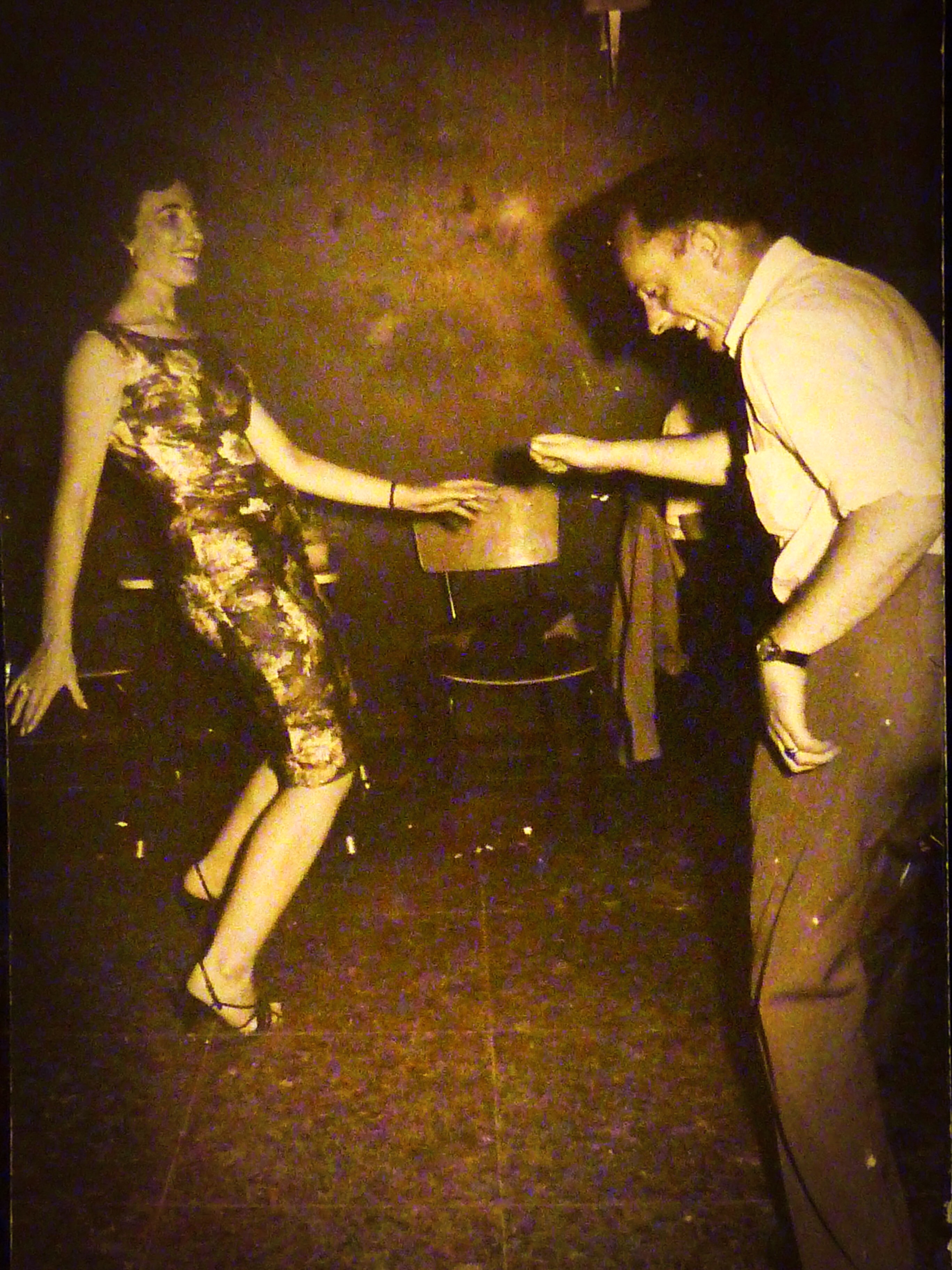
Angela’s parents Joyce and Jimmy Slaven cutting a rug on holiday in the 1950s.
What did you want to be when you were growing up and what attracted you to becoming an editor?
AS: My dream jobs would either to have been an architect or a writer/journalist, but my creative writing skills were average and I wasn’t great at maths. I studied English Literature and Film and Television at Glasgow University and as part of the film course had to make a short film on videotape. Ours was called The Princess and the P – no spoilers but the P turned out to be the letter P written on a scrap of paper which blows away at the end, for some reason. But it was when we got to the editing stage that I had a kind of eureka moment, realising the possibilities of manipulating sound and pictures separately. This sounds like stating the bleeding obvious, but I hadn’t really grasped the power of it till being involved in the rudimentary video we were making.
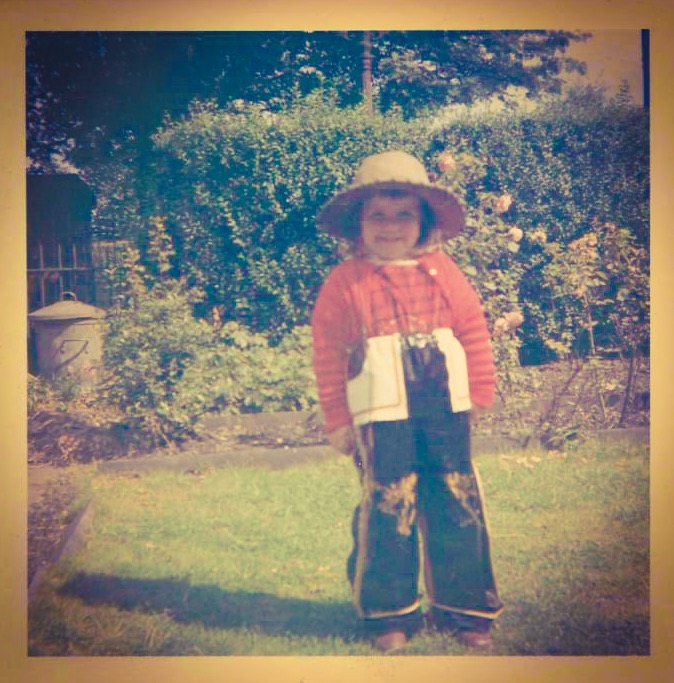
Portrait of the Artist channeling John Wayne.
What films or TV series which inspired you? What about directors or editors?
AS: I do remember late one night, perched on the arm of the chair nearest the TV, switching the set on and O, Lucky Man!had just started. I was riveted (uncomfortably) to that spot for the entire duration of the film. So that was an inspiration. I love Hitchcock, Powell and Pressburger, Lynch, all the usual suspects. But I hugely admire films where the sound design is really bold. I’m thinking of films like All the President’s Men, where music is used sparingly but very effectively. I love music, and I love working with music and sound design in films, it’s my favourite part of the process, but I don’t like music being overused which happens a lot. It’s like an additional character, making a statement or punctuating a thought or adding a layer of unease or happiness or whatever, and loses a lot of power if overused.
How did you start your career?
AS: Synchronicity is everything really. I temped for a while after graduating, and as luck would have it was sent to Scottish Television to work in the Mail Room. It was so showbizzy then – Arthur Montford would say hello when he passed in the corridor, imagine! And the place was dominated by the PAs, a troupe of formidably glamorous women who had a corridor all to themselves. Think Lauren Bacall, Kathleen Turner, Sophia Lauren and you’ll get the idea. But I basically hounded the editors, sitting in with them whenever possible, and one of them recommended I call the Head of Post Production at the BBC, John Grove. As luck would have it, I called on the Friday and a job syncing up film rushes had just become available, and so I started in the portacabin at the back of the old BBC building in Queen Margaret Drive – alongside now renowned Scottish film editor Colin Monie who I’d been at Uni with – where squirrels played on the roof.
I can still remember the smell of the polish in the lift when I would be ferrying the film cans on the way to the cutting rooms, which were arranged in a circle around a turret. It was magical. I think the first drama I worked on was with wonderful film editor Dave Harvie on a single play called These Foolish Things, starring Lindsay Duncan and James Fox. I had the grand title of Second Assistant which generally involved making tea, hiding under the trim bins when a viewing was in progress to be as inconspicuous as possible, and learning to love whisky when the Bowmore appeared from the filing cabinet late on a Friday afternoon. All very useful life skills. This particular play was directed by Charlie Gormley and produced by Andy Park – they were a great double act, very funny and very generous. We’d occasionally all jump in a cab and go to Babbity’s or the Caprese in Buchanan St for lunch on their tab, very exotic for a newly ex-student like me used to eking out my grant in the Grosvenor Café. Those days were an education in many ways.
You worked as a dubbing editor – what does this mean and what does the work entail?
AS: A dubbing editor – well, you can get away with ropey pictures but not really with ropey sound, so dubbing editors are key. The role is usually called Sound Designer now. There are different areas of expertise within the scope of the job, depending on the scale and budget of the production.
For example the Dialogue editor will smooth out recorded dialogue, replace takes if something is unclear or background noise interferes, oversee additional dialogue recording (ADR).
The FX editor will layer up different sound FX, background atmospheres, creating a unique soundscape from thousands of different sources, often recording sounds if necessary to enrich the soundtrack.
The foley editor will supervise a foley session which involves the live recording of footsteps and sound FX to mimic what you’re watching onscreen, from spectacles being lifted up and pages turned, to stabbing cabbages to simulate gory murder scenes (as seen notably in Berberian Sound Studio, but Taggart was way ahead of the curve!).
I was incredibly lucky on a couple of occasions as an assistant dubbing editor to work with the mighty ‘Beryl the Boot’, I think it was on a 1997 Hallmark film called The Ruby Ring which starred Rutger Hauer, Judy Parfitt, and a lot of horses. Beryl Mortimer was a legendary foley artist ( she’d worked on Lawrence of Arabia!) and specialised in equine scenes, so she was brought up from London by our sound designer Douglas MacDougall, strode into the dubbing theatre with immaculately coiffed hair and a fetching white pants suit, and opened her case which contained an array of chains, leather belts and handcuffs to simulate the reins and bridles; coconuts to simulate the larger horses, and ‘donkey nuts’ for the smaller ones. I can only imagine what the customs man at Glasgow airport must have thought if he’d opened it up.
As an aside, I was also an assistant editor on that film, working with John Gow the editor of Gregory’s Girl which was and remains one of my very favourite films, so that was a treat.
How do you work as an editor? What is the difference between scripted programmes and documentaries? How do you navigate each?
AS: I’ve worked on both scripted and unscripted, and both are very challenging in different ways. In drama you’re working with a script, and although the structure can change sometimes radically from the original premise, there is at least a framework to get started with. With a doc, yes sometimes there will be a shooting script and a general outline of how the film might take shape, and a director with great ideas, but sometimes there is just a huge pile of material and a vague suggestion of how it might take form. It’s a bit like having a jigsaw with no picture, many of the pieces missing and quite a few thrown in from another puzzle altogether.
In both forms there is a huge amount of input required from the editor in terms of structuring and pacing the programme or film, as much responsibility as you want to take on really. Obviously, this is slightly dictated by who you’re working with, but most directors are extremely collaborative and very happy for someone to have fresh eyes on the material after the shoot, which can be an intense and stressful time. The cutting room is often like a therapy room, and a large percentage of the job can be counselling. What happens in the cutting room stays in the cutting room!
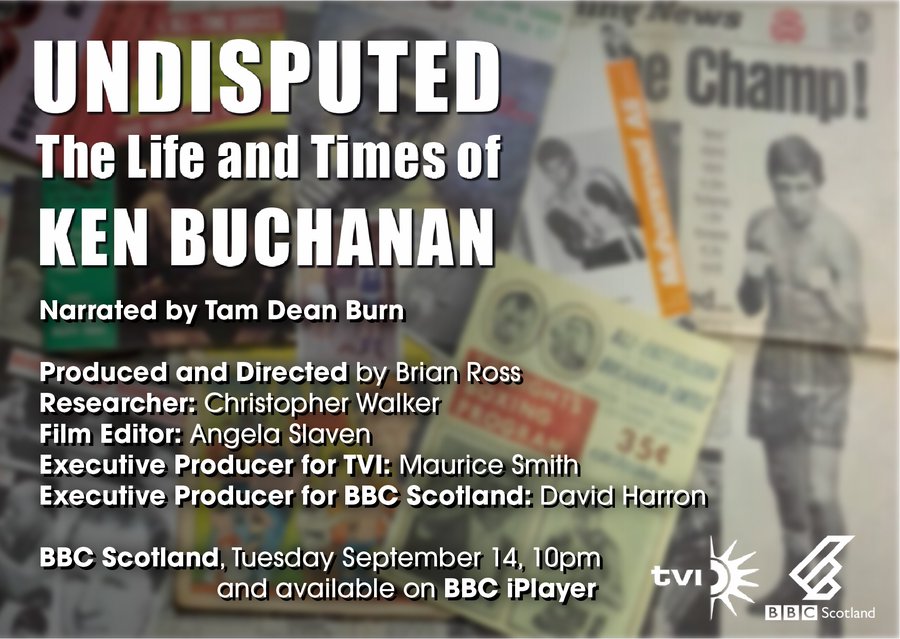
But what both of these forms have in common is the massive impact that the placing of music and sound design have on the rhythm of what you’re putting together. In the edit the editor is often responsible for choosing what the music is and for deciding where it goes, so I spend a lot of time sourcing music, whether commercial or library music, or if the budget allows, working with composers, and this is the most creative part of the process for me. An example would be Undisputed: the Life and Times of Ken Buchanan, about champion Scottish boxer Ken Buchanan, directed by Brian Ross. For a while I was pondering what would work musically for the fight scenes – didn’t want to do classical, too Raging Bull. Rock would be too…Rocky! Ken’s parents loved ballroom dancing, so I kept coming back to that and thinking about different types of dance music, and it was when I tried some big band jazz (Louis Prima style), it suddenly clicked. We were so chuffed on behalf of Ken to win an RTS Award for that in 2022.
What are your decision processes when editing? How do you know when to cut?
AS: Synchronicity again! Sometimes it’s accidental, something unintentional will happen and you think, ooh that works. Sometimes it takes hours of tweaking sound and pictures and music, it’s really not a spectator sport. I saw editing legend Thelma Schoonmaker answer this question last year during an interview, in which she was asked this three times. The first two times she patiently explained how she’d watch sequences over and over to get a feel for them, she’d think ‘Hmmm, needs a bit more of a pause here, less of a pause there, too long now, too short now’, make tiny adjustments etc. The third time she was asked she just said ‘It’s my job’! I did love that because it’s quite hard to explain, it really is just a case of getting a feel for the sequence, and once you have a version you feel can be watched in one go rather than scrutinising frames here and there, literally standing back from the screen to see it objectively as a viewer, and trying not to let all the other many choices you could make intrude.
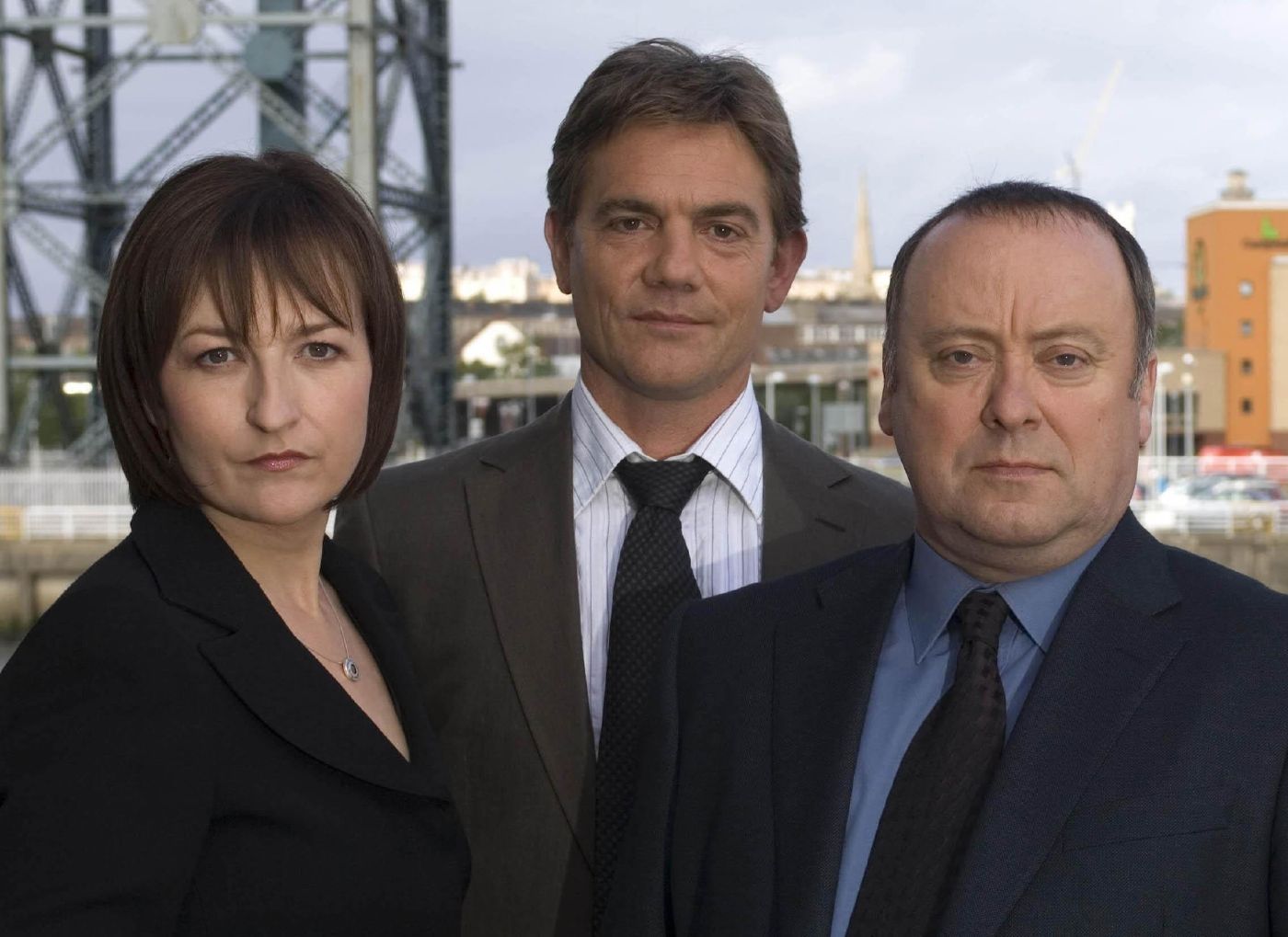
‘Taggart’: Blythe Duff as DS Jackie Reid, John Michie as DI Robbie Ross and Alex Norton as DCI Matt Burke.
Would you tell me about the hugely successful and long-running detective series editing ‘Taggart’? How did you become involved in this series and how did you work as an editor?
AS: I’ve worked over three decades, starting on film then videotape then nonlinear (Avid) editing. A couple of years after I started at BBC Scotland, I was offered a permanent job as an assistant at the BBC OUPC (Open University Production Centre), so moved to Milton Keynes for three or so years. It was a great place to work, but I was desperate to get back home. I would watch Taggart to get my Glasgow fix and dream about working on it one day, which did seem pretty impossible to be honest. Anyway, I remember very vividly on Children in Need day 1993 I got a call from Bob Dowie, head of post at STV at the time, to offer me a job back in Glasgow, so I leapt at the chance. After a while I worked my way up to dubbing editor, while Mark McManus was still the lead, and then editor on Taggart, which felt a bit unreal.
Although I work mainly on docs now I did originally work more on drama, but recently cut a series called Skint, 8×15 min short films on a theme of poverty. I’d worked with producer Carolynne Sinclair Kidd years before on a series called High Times, a very funny counter cultural comedy drama which won BAFTA for best series in 2004. Skint was mostly written and sometimes directed by people who hadn’t been involved with TV before. It involved a great cast of actors, including the likes of Michael Socha, Saoirse Monica-Jackson and Peter Mullan. And great writers and directors, amongst them Cora Bissett, Jenni Fagan, James Price, Lisa McGee. This happened during the latter stages of covid so I worked home alone, sending cuts to the directors. The schedule was one week per film; essentially a couple of days to look at rushes and pull together a rough cut, find music, send to director, then work on notes, refine, get the time down and have the film signed off on day 5. It was a tight turnaround but I loved this project, it was so interesting to work with different people/different styles one after the other like that.
The impetus to work more on documentaries came about when I went down to London in 2003 to cut an observational doc called Don’t Drop the Coffin, set in an undertaker’s business in Bermondsey. The characters were fascinating, the subject matter was sensitive, and it was the first time I’d been up to my elbows in an ob-doc series so I got a real taste for it. I love working on Arts and Social History docs especially, and have made quite a few for the BBC with Independent Producer Maurice Smith and the same team of female directors (eg Sarah Howitt, Shruti Rao, Margaret Shankland, Alison Pinkney), Directors of Photography and assistant and archive producers, who are just brilliant, intuitive and practical.
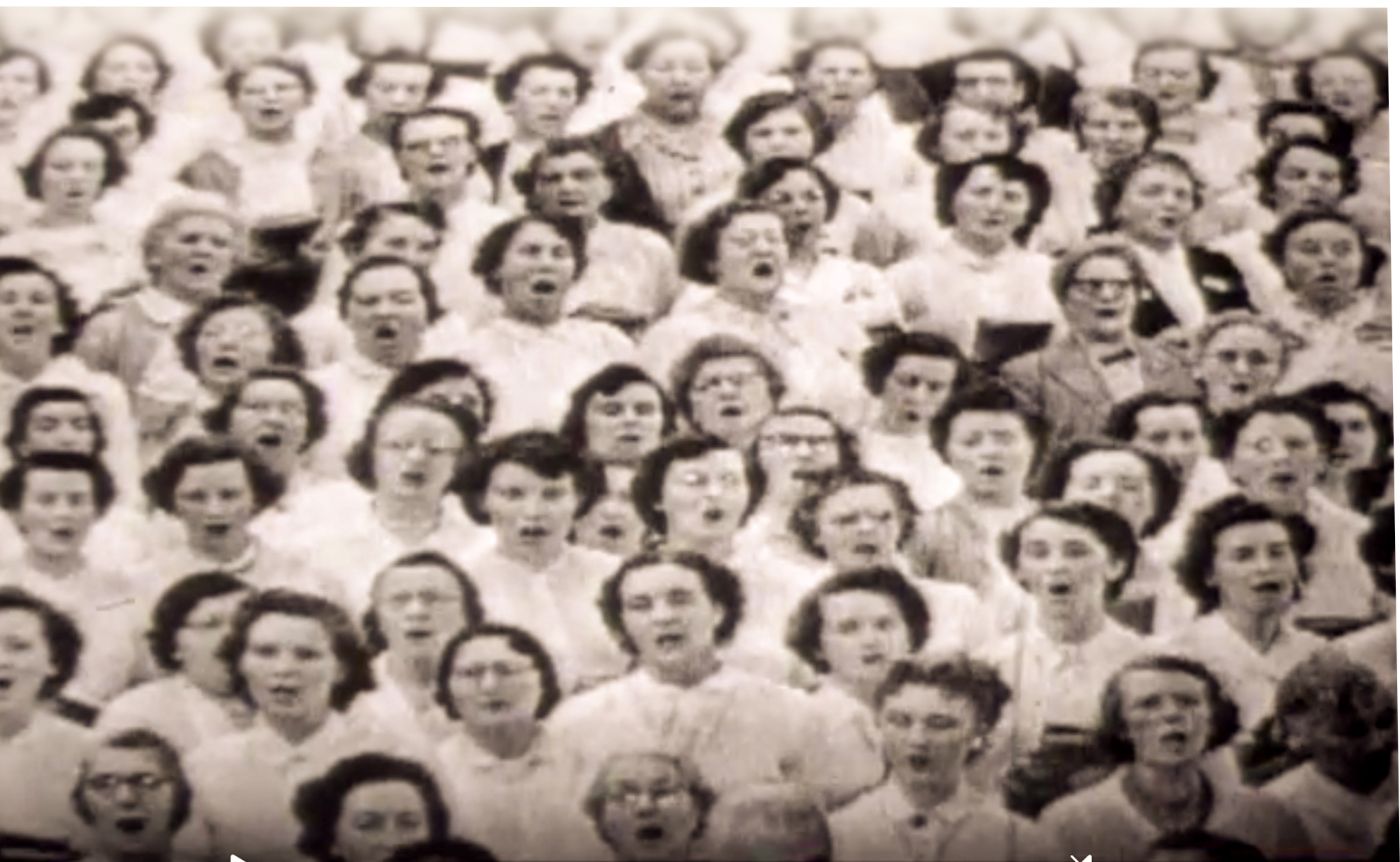
One doc in particular is a favourite of mine – Six Weeks to Save the World (directed by Sarah Howitt in 2018) which charted the phenomenal reach of American evangelist preacher Billy Graham as he took up residency at the Kelvin Hall in Glasgow for six weeks in 1955. I remember my Mum telling me that my Uncle and my Gran had been there, she was in fact in the choir. There is a lot of archive footage from the event, which I scoured, and did in fact spot my Gran! Composer Kenny Inglis composed a wonderfully atmospheric score for this programme. We had a few long chats about the sort of Boards of Canada-y analogue-y sense of disquiet that might work and it really did.
Angela’s Grandmother Elizabeth Smith singing in the choir for Billy Graham’s Glasgow Crusade, 1955. Elizabeth is in the middle of the bottom row wearing glasses.
AS: Two other programmes I’d mention in particular are Artworks: Michael Clark’s Heroes. directed by Michael Prince in 2009, which followed enfant terrible post punk ballet dancer Michael Clark in the year where he was presenting a David Bowie- based performance both at the Venice Biennale and the Edinburgh Festival, and a doc I made with Director Alison Pinkney in 2018 for Sky Arts, Ivor Cutler by KT Tunstall.
I’ve worked with Michael many times and I think the first thing we made was a doc about Franz Ferdinand. He shoots beautifully and is also a great Stills photographer, but the best thing about him is that he’s always questioning things. Each morning he comes in and the first thing he says is ‘are we missing a trick here?’ So we’d go back and interrogate how we’d structured such and such a piece. No complacency. And we also got into trouble for laughing too much from the adjacent cutting room!
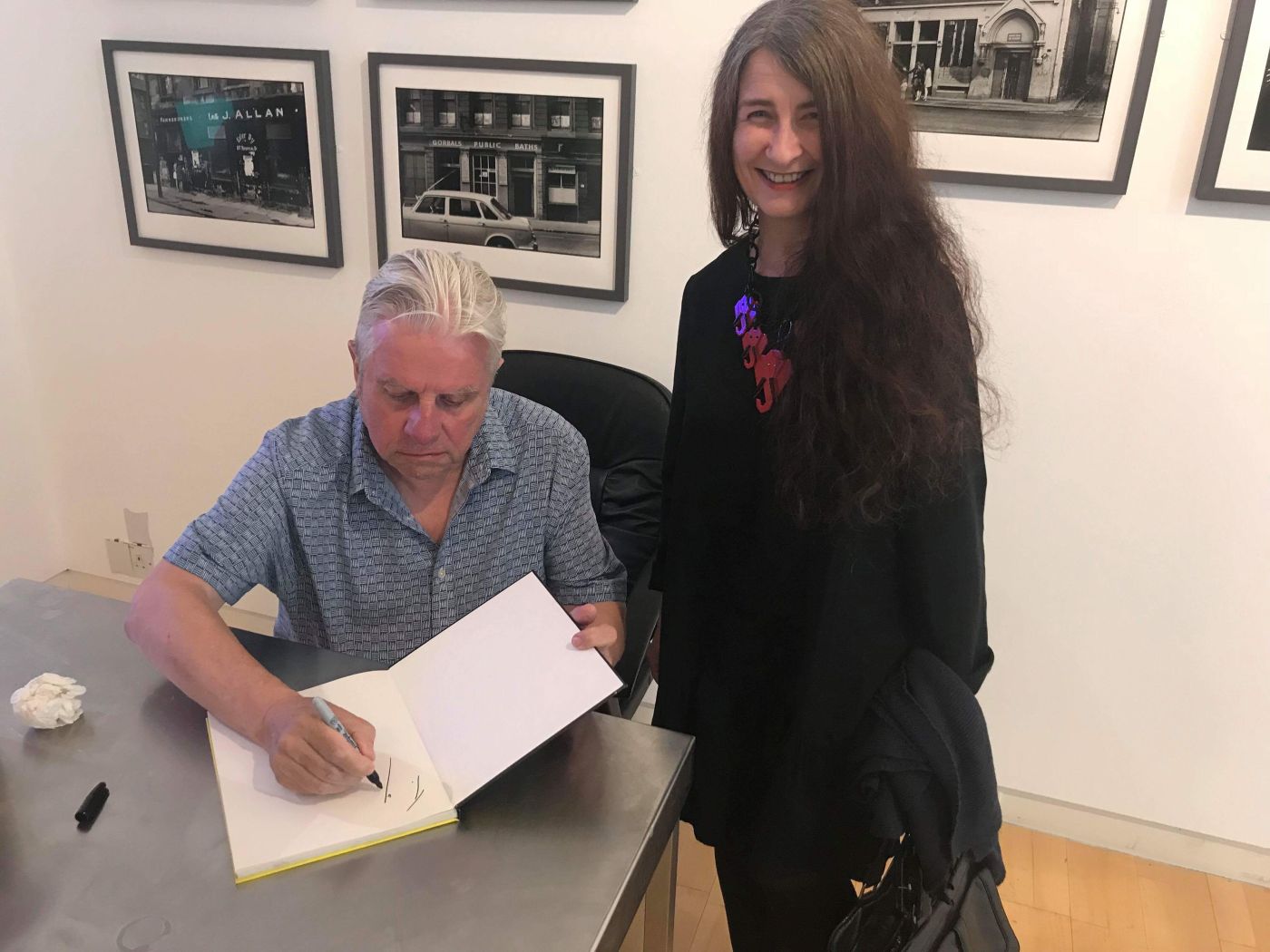
Angela with filmmaker and photographer Michael Prince at the opening of an exhibition of Michael’s landscape photography.
AS: I normally dislike watching anything I’ve worked on as I can always see things I should have done better, but one favourite edit is in this programme. There’s a scene where we go to Venice where the Bowie choreography is happening. Michael Clark visits Stravinsky’s grave in San Michele cemetery, over which we hear Rite of Spring. Then over a few shots of Venice and London we’re back to the London rehearsal room. I couldn’t quite get the transition to work, then all of a sudden I could hear in my head the Aladdin Sane music emerging from the Stravinsky, and that’s what made the transition. I realise it’s not as impressive as editing a flashy opening montage for a Bond film but it pleased me! Later on I worked with Michael on a film he made about the brilliant photographer Brian Griffin, The Surreal Lives of Brian Griffin.
Photographer Brian Griffin (1948-2024) with Angela Slaven. Photograph: Michael Prince.
AS: Brian was a great subject as he was quite intense, idiosyncratic, very funny and hugely talented. Strangely he also features in the film I’m working on just now, ‘The Revolutionary Spirit’, about the Liverpool music scene of the late 70s/80s, as he was famed for his record covers including those for Echo and the Bunnymen and the Teardrop Explodes. I’m so glad Michael had the foresight and determination to make that film as Brian died unexpectedly last year and is hugely missed, what a talent.
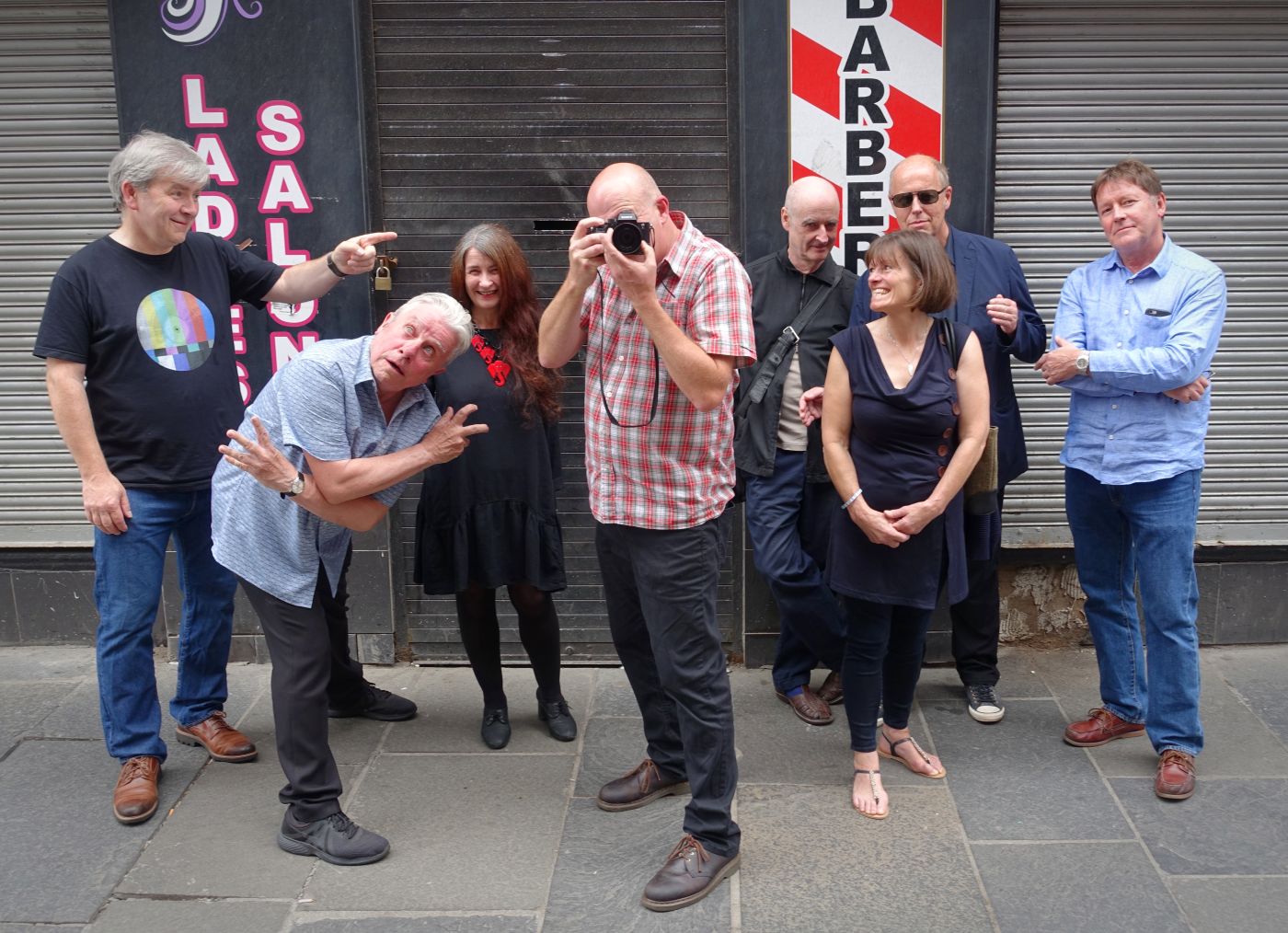
Team Griffin. Malcolm Lindsay, Brian Griffin, Angela Slaven, Michael Prince, John Butler, Cathy Stokes, Cy Jack, Ian Ballantyne. Photograph by Douglas Corrance.
AS: The Ivor Cutler doc came about because I’d earlier worked with director Alison Pinkney on a film called Team Tibet, a passion project she’d filmed while working in India on another project. While there she’d met some Tibetan exiles who were setting up their own amateur Olympic team as they were banned from playing in the Beijing Olympics that year, so she filmed this off her own bat, along with producer Shruti Rao, a translator and small crew. They did a beautiful job and it’s a very moving film. Obviously quite difficult to film and work on something in a language you don’t speak, although we had onscreen subtitles, and that presented a few challenges as it was difficult to cut down until we could get hold of a translator who could guide us through the syntax and ensure things still made sense. Anyway, it played in festivals worldwide, winning the Best Self-Funded Film at Cine Pobre in 2019. As the Chinese Government take a dim view of any supporters of Tibet, we did wonder if we should change our names for the credits (we didn’t), but googled what our anagrams would be – as I recollect, I was Elven Lasagna and she was Insanely Pinko, a name which stuck!
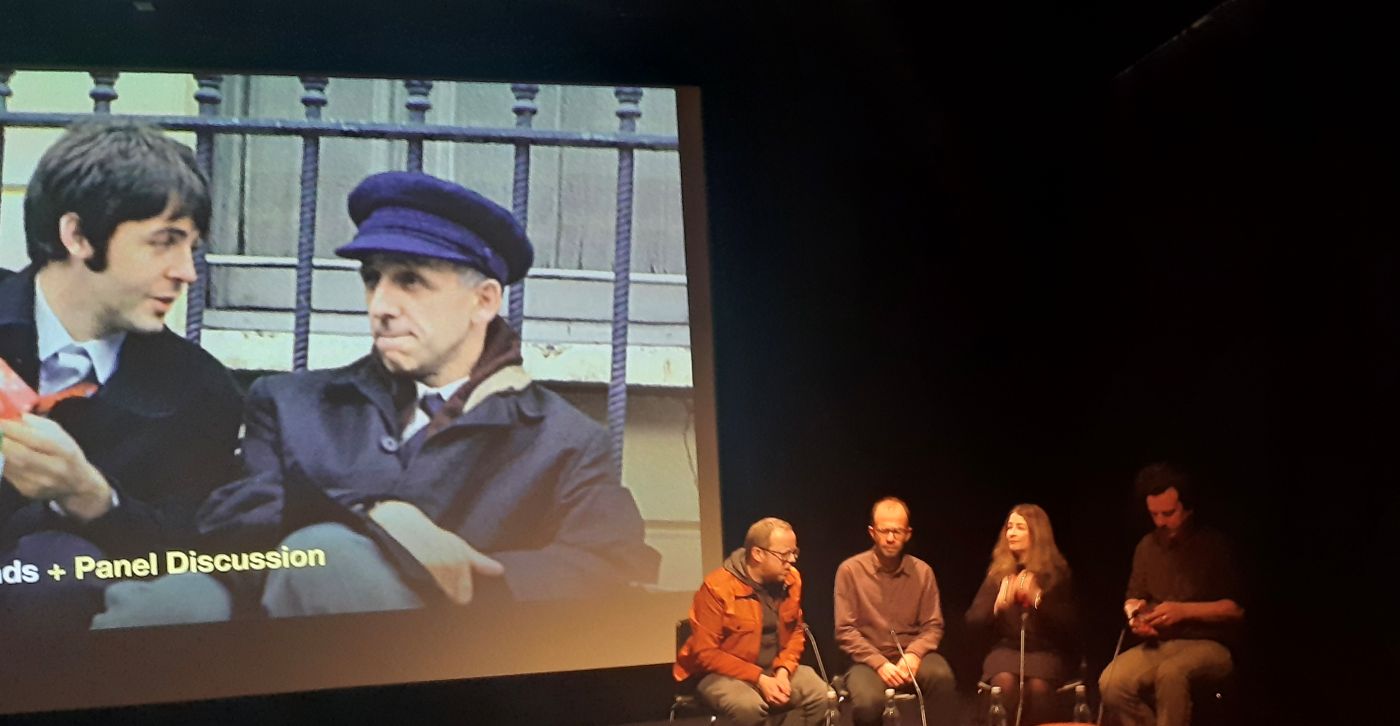
AS: The Ivor Cutler doc we went on to do was presented by KT Tunstall, and included interviews with Ivor’s son Dan, his old BBC producer Piers Plowman, and his wife Phyllis. As a fan of Ivor – and someone who had timidly gone up to him back in the 80s at the Edinburgh Book Festival to say ‘Hello Mr Cutler’ and been given one of his famous stickers – it was a dream to do. I didn’t know much about KT but she was a true fan, a brilliant interviewer, genuinely interested in all the people who appeared and sang Ivor’s songs beautifully, guided by Alison’s very sensitive direction. It went on to be nominated for a Scottish BAFTA, and as Alison is pretty shy, I ended up at a Q&A at the BFI in London talking about Ivor as part of the Eccentric Miscellany Festival in 2023.
You made two music documentaries with Grant McPhee ‘Big Gold Dream’ and ‘Teenage Superstars’ in which you were editor as well as writer and co-producer. How did this come about?
AS: After working on the Brian Griffin and Tibet films, I started getting more into indie filmmaking (aka no budget and you do it in your own time because you love it). A great director friend of mine Becky Brazil put me in touch with Grant McPhee, as she knew I’m a massive music fan and I came of age musically speaking with many of the bands featured in Big Gold Dream; Josef K, Fire Engines, Orange Juice, the Associates etc. So when Grant outlined the project to me, I was in! It was a huge privilege for me to sit there going through hours of interviews with the likes of the spectacularly funny Davy Henderson, Malcolm Ross, Alan Rankine, Paul Research, Thurston Moore, Douglas Hart and so on.
AS: I didn’t at the time realise quite what a huge undertaking it would be in that so many people had already been interviewed – I think in the end there were 70+ interviewees for what turned out to be two feature length docs. It’s a lot of material a) to go through, b) to work out a structure for, and c) to find archive for. Also of course a huge difference when you’re used to working with a bigger team and there are people responsible for scripting, archive and music research, etc, but this was just the two of us until producer Wendy Griffin came on board, working remotely; me sending cuts to Grant and trying to whittle things down and him sending notes back.
But Grant is an amazing archivist and has the collector’s gene, he doesn’t rest until he’s unearthed every scrap of evidence and spoken to every person relating to a story, and is great at pointing up any inconsistencies or areas that need greater attention, that I might miss.
I did accidentally end up writing the VO for the films though. Writing is not my forte so I kept it as minimal as possible, imagining that a professional would be brought on at some point to reshape it properly. But that never happened! So I had the pleasure/pain of hearing the Go-Betweens’ Robert Forster and the Pixies’ Kim Deal reading the words wot I wrote, in true Ernie Wise style. Big Gold Dream went on to win the Audience Award at the Edinburgh International Film Festival in 2015, which was completely unexpected and amazing, so I guess we must have struck a chord somehow (no pun intended!).
You worked with Jim Burns on ‘It’s Not All Rock ’n’ Roll’ – how did this come about?
AS: Grant knew Jim was looking for an editor for his follow up toSerious Drugs and put us in touch. Jim invited me round to look at some of the rushes for the doc, about US/German band Swearing at Motorists fronted by extrovert singer Dave Doughman – sending me a brilliant little hand drawn map from the train station to his flat, which intrigued me right away. As soon as I saw the material I absolutely loved it. He has such a great eye and is very lateral thinking and therefore very insightful and inventive. He’d followed this band in Germany and over to the States on a road trip, filming everything himself. We went over to Hamburg to show the film to Dave before anyone else saw it, and screened it in the St Pauli stadium as he’s a huge St Pauli fan. It was quite emotional, I don’t think he knew what to expect.
How difficult is it to get programmes commissioned and made? Has the process changed over the years? How? Why?
AS: It’s becoming very difficult to get programmes commissioned/films made nowadays. Broadcasters like to play safe, they tend not to go for single docs, as there’s more return on a series. The arts seems to be a dirty word. Funding for films is so difficult to get; there’s just less money around. It’s becoming more frequent that you almost have to make the film as proof of concept in order to attract funding, which means it takes a long time as you still have to do your day job to earn money.
Next came a brilliant documentary on the Pet Shop Boys. What was that like?
AS: I am a huge fan of the PSBs so was delighted to be asked to make this film, particularly since the director was Lou Lockwood who is terrific and I’d wanted to work with her for ages. I was worried that maybe they might disappoint a bit, not be as lovely or as funny as I’d imagined, but the opposite was true, absolutely brilliant, the pair of them, very funny and courteous. And I still love listening to the music! Sometimes when you work on something for a while you can’t listen to those tracks for a long time, but not with them. And we got to go for dinner with them! So that was very exciting.
You recently worked on ‘Reality is Not Enough’ about Irvine Welsh. What was this like?
AS: We started cutting Reality is Not Enough in January 2023. Director Paul Sng already knew Irvine, and the genesis of the film had come about one night when they’d gone to see the Todd Haynes’ Velvet Underground doc together, and Paul had asked Irvine if he might be interested in being filmed himself. He teamed up with Edinburgh based company LS Productions and with a small crew followed Irvine Welsh all over the world for a year– Miami, Dublin, LA, Toronto, etc.
The film evolved a lot from the initial premise, which was Irvine in conversation with old friends in all these parts of the world. It gradually became more introspective, and the device we used to frame it was a controlled drug trip Irvine goes on while in Toronto at a book fest. We’re then inside his mind, and Paul cleverly filmed this using historical archive in a warehouse with Irvine wandering through, while he reflects on his life in voiceover. We paused the post production of the film for a few times, while more filming was being organised, so although it didn’t come out till August 2025 we weren’t working on it throughout. Again I worked mainly from home alone and sent cuts to Paul, and he’d come over to Glasgow and perch on the uncomfortable chair in the living room with a tiny table, no mod cons other than a plate of cookies, and go through notes with me. Paul is a very collaborative director with a positive attitude and vision. He managed to enlist a fantastic array of names to read from Irvine’s work, including Nick Cave, Stephen Graham, Maxine Peake and Liam Neeson.
Director Paul Sng with Angela Slaven at the Edinburgh Film Festival premiere of ‘Irvine Welsh: Reality is Not Enough’, August 2025.
AS: Maxine is the connection with Tish, another film I’ve worked on with Paul, as she narrates the voiceover. The film is a profile of Northern working class photographer Tish Murtha, seen through the lens of conversations between Tish’s daughter Ella and old friends, colleagues and family. Tish was already in post production with my good friend, Edinburgh based editor Lindsay Watson cutting it. During one of the longer breaks in Irvine I was brought on to make a 60 minute version, then it was wisely decided that that would essentially bastardise the film so it never happened. However the film kept evolving after that so I was lucky to be able to carry on working on it till the end. Tish herself was never recognised properly in her day, and Ella, force of nature that she is, has ensured that this has been rectified and Tish’s work is now in the permanent collection at the Tate. Interestingly I’ve read interviews with Ella and also with Irvine Welsh, and both said “there’s no one else I would let tell this story”, which speaks volumes about the level of trust they had with Paul (and also Jen Corcoran, Producer of Tish and Sarah Drummond, Producer of Reality).
The great thing about both of these projects is that they had two brilliantly intuitive composers attached, Alex Hamilton-Ayres on Tish, and Donna McKevitt on Reality. I don’t have a great musical vocabulary but each were geniuses at interpreting what was required at each level of the score as it went backwards and forwards with each cut.
Can you tell me what you’re working on next?
AS: Synchronicity – again it plays a major role here! I’m currently working with Grant again on not one, not two, but three feature length docs spanning the arts, music and culture scene in Liverpool from the early 70s to the mid 80s. This project has a long genesis. The very first time I met Grant – we met in Mono for a coffee – he was outlining what turned into BGD and I remember mentioning to him that it was odd that the Zoo Records story had never been properly told. That was that. For the moment.
A few years later the idea was resurrected. Grant by this time knew Dave Balfe and Bill Drummond, and I put him in touch with a friend of mine Paul Simpson from the Wild Swans, who is not just a brilliant musician but also a great raconteur, and he knows everyone as he was at the centre of that scene. (His memoirs Revolutionary Spirit: A Post-Punk Exorcism came out last year and are well worth a read). Again, that was that. Then a couple of years later some short film clips appeared in my inbox, sent by Grant – he’d been filming Paul in Liverpool. And also filmed, rather wonderfully, Bill and Dave in bed like Morecambe and Wise, reliving their 40 year friendship, talking about the Zoo story, all the personalities involved and generally winding each other up. Charming and fascinating.
Since then Grant has enlisted many other great characters such as Will Sergeant and Les Pattinson from Echo and the Bunnymen, Mick Finkler and Gary Dwyer from the Teardrop Explodes, Pete Wylie, the indomitable Queen of Eric’s (and indeed Liverpool) Jayne Casey, Andy McClusky, Paul Rutherford and many more. Not only that, Grant then unearthed the story of the heart and soul of the predecessor to the Eric’s/Zoo era – The Liverpool School of Language, Music, Dream and Pun, an arts hangout based in a converted warehouse in the famous Mathew St, erstwhile home to the Cavern. It was started by poet and Jungian disciple Peter O’Halligan. [Carl] Jung had never visited Liverpool but in 1927 dreamed of finding himself in this “dirty sooty city”…”Liverpool is the Pool of Life”. He believed that synchronistic events are a reflection of the subconscious, that coincidence and chance can be meaningful, that things can have more than one way of making sense. Hence the inclusion of ‘Pun’ in the name of the School. And it would see the likes of Jim Broadbent take to the stage with Ken Campbell’s 23 hour long staging of Illuminatus!. Carol Anne Duffy and Bill Nighy hung out there. Letter to Brezhnev director Chris Bernard started as stage manager there. Bill Drummond was a humble carpenter, manufacturing complicated 3D collapsible sets from virtually nothing but sheer imagination. It is a truly fascinating tale, we have incredible film archive from Chris Bernard to illustrate it too, and Peter is a unique other-worldly character with a vision and a philosophy, but he is a do-er as well, he makes things happen, same with Bill Drummond. They have wonderful magical ideas and make them happen. Very inspirational.
Anyway, we have no money or funding so I’m not sure if we’ll ever get these finished but at the mo the first and third films are at a good rough-cut stage. We just need a philanthropist to help ease the way!
With thanks to Angela Slaven.
‘Team Griffin’ – Photograph copyright Douglas Corrance, used by kind permission
Angela Slaven editing and Angela with Brian Griffin – Photographs copyright Michael Prince, used by kind permission.
I don’t know how Peter Boyd Maclean isn’t more famous than he is. It’s one of those Arthur C. Clarke Mysteries. You know the kind where the big question being asked is: how the fuck doesn’t everyone know about this guy? That is, in other words, how the fuck don’t the majority of people know about Peter Boyd Maclean? It’s probably part of the reason I originally set up Planet Paul way back in 2010 to give light to those who deserve blessings from the Great God of Luck for their Natural Born Talents, etc. etc.
I’ve known Peter for well-on thirty years and have always marvelled at his brilliance as a filmmaker, artist, musician and all-round-good-guy. (The last is a bonus point in my book.) Most people in TV or Film have sharp elbows intended to keep you away from a fair share of the main course.
I first met Peter when we worked together in the Music & Arts Department or as one wag named it the Musical Farts Department at BBC Scotland in the early 1990s. He seemed like a teenage wunderkind whose talent was never quite fully appreciated by those idiots who run the meejah. You know the kind of people. Those people who think beige is the most fashionable colour and wish the Guardian did horoscopes.
Peter first came to note as one-half of the twinset and perils known as the Duvet Brothers, alongside Rik Lander. If you’ve never heard of the Duvet Brothers then Duck-Duck-Go the scratch videos for Pump Up The Volume or Blue Monday both of which changed promo-vision and accidentally unleashed Adam Curtis-style documentaries upon the world. The Duvet Brothers changed television and film. But sadly, like all good nursery stories in search of a happy ending, they got fucked over by the conglomerates who saw their unique and original work as something to be retooled for their own petty ambitions.
Plus ca change plus ca meme chose.
Peter progressed on to a very successful career as director/producer with the BBC and Channel 4, making documentaries and series as diverse as In Search of Steve Ditko, Pete & Dud: The Lost Sketches, Crapston Villas, and Banzai. In 2009, Peter wrote and directed the short film documentary in collaboration with the artist Millree Hughes called Lummox which deconstructed the whole concept of documentary filmmaking with a nod to Lacan’s theories on destructive envy.
Okay, you’ve had the intro, so now let’s find out what Peter or rather the Duvet Brothers are doing right now.
This week the Duvet Brothers present an immersive theatrical experience called Ritual Virtual – Inside the Sacred Rituals which is based on the Greek myths surrounding the mother and daughter Demeter and Persephone. Now, if you’ve never heard of these characters you should have a quick butchers of Robert Graves’ classic books Greek Myths Vol I and Vol. II. In fact, we’ve got Robert here (He’s dead – Ed.), so what’s it all about, Bob?
Robert Graves (for it is he!): I’m glad you asked, Planet. Demeter was the ancient Greek goddess of the harvest. Or death and rebirth, if you will. Now, as is typical in these Greek myths Demeter had a beautiful daughter called Persephone.
One day, Demeter and Persephone were walking through a beautiful meadow admiring the bounty of Nature, when whop, bang, fizz, Hades, the rascal and god of the underworld appeared and decided to steal Persephone away for his own wicked and disgusting ways.
Unsurprisingly, Demeter was well pissed-off as any mum would be when some random abducts her daughter. So, Demeter decides she will fuck-up the harvest by bringing winter upon the land and destroy all of the crops – fruit, vegetables and any of those Whole Foods outlets that were around back then. Serious shit, as you can imagine. So much so, that ye great god and nasty mad-shagger Zeus has to intervene.
Zeus goes down to kick Hades’ butt. But, Hades says, Persephone can only leave if she hasn’t eaten any of the food he has given to her. Thankfully, Persephone hasn’t touched the Maccy D’s or the KFC but unfortunately for her, she has devoured a pomegranate which now means Persephone is stuck in Hell.
Zeus being Zeus comes up with a deal. Persephone will spend six months in Hades and six months with her mum Demeter. Obviously, this was way before women had any rights. Hades accepts the deal.
So, now Demeter has her daughter back for six months of the year, which becomes the time of spring, summer and harvest, while Hades has Demeter during autumn and winter or the time of death and rebirth. This is where seasons come from. (As if – Ed.)
This is only part of the story as Demeter and Persephone were honoured in ancient times in an annual festival known as the Thesmophoria which celebrated human and agricultural fertility at harvest time. These festivals were held by women and involved a series of sacred secret rites known as the Eleusinian Mysteries which focus on the abduction of Persephone, Demeter’s search for Persephone, and finally the ascension or rebirth of Persephone. These rituals tied into concepts of eternal life through fertility and the possibility of an afterlife.
What is ‘Ritual Virtual’ about?
Peter Boyd Maclean: It is a recreation of the celebration of Demeter that took place for over a thousand years at the temple of Demeter on the Eleusis known as the Eleusinian Mysteries
How did you become involved in it?
PBM: I conceived the idea as a documentary and a possible VR experience. Then Rik [Lander] my old Duvet Brothers partner said that University of the West of England were commissioning projects to showcase their brand new tech centre that had robots and a studio with 22 speakers surround sound and a massive screen.
So we adapted the idea to suit the brief
What attracted you to the story? Why this story?
PBM: The story attracted me because I discovered that during the rituals they would imbibe a hallucinogenic drink called kykeon. They say this drink was made with some of the barley which came from the bakery next to the temple. This barley was supposedly infected with the fungus ergot which causes hallucinations. Many centuries later, Albert Hoffman made LSD from ergot sparking a cultural revolution of the 60’s
The participants at these rituals would have revelations, and overcome their fear of death.
Plato was alleged to have been inspired to write about the Cave of Shadows which Carl Jung picked up a couple of thousand years later. I also like the idea that the fathers of modern (well up till a a few years ago) civilisation, Plato and Aristotle developed their ideas while under the influence of hallucinogens in week long festivals. A couple of thousand years later we got Woodstock and the Grateful Dead, Sgt Pepper’s etc
Demeter was the God of the harvest, birth, death and rebirth and this was something that deeply interested me.
A few years ago I went on a retreat involving ayahuasca and I had revelations that helped me deal with the prolonged low-level grief I had after my brother died years ago. It all came up and I received a message which helped enormously.
What was the message?
PBM: ‘Tend to the living.’
I realised through an internal dialogue with myself I had been tending to the grief, keeping it alive as it was my connection to my brother I suppose.
It was like a medieval saying, tending to the garden, tending to the grief and the strong message was tend to the living, to my kids. Loved ones. Everyone.
I wrote the song and then the Greek myth of Demeter’s search for Persephone her grief then the acceptance of life death rebirth
They were clever them mythmakers no wonder they still inspire.
You say it’s immersive, can you explain what this involves?
PBM: It’s immersive theatre, the mystics, or initiates or punters go through the initiation that the ancient Greeks did at the temple except they didn’t have the advantage of robots haha and they don’t take drugs so they experience stuff through the VR headset instead
I made the VR headset film over the last six months and am producing the live stuff with Rik.
Gary Bridgewood my partner from our band Book of Shame has composed a fantastic soundtrack that takes us to the Underworld and back in a continuous swirl of emotions.
I want to also give special thanks to Peter McAuley at BorisFX who helped me through the technical SF nightmare
Zoe Portela in ‘Virtual Ritual’.
Apart from Virtual Reality and robots who is in the production?
PBM: Zoe Portela a fantastic singer and performer I’ve been working with is Demeter in the VR and the high priestess for the initiation ceremony
Gary is playing live and Zoe will also sing a song at the end of it.
Ceri Seel is an academic and Ancient Greece expert and does a lot of rituals
Brad Crowley is the town crier of Glastonbury and a host that guides the initiates through to the ceremony.
Marie Helen Boyd is another guide to the initiates.
What do you think people will experience from ‘Ritual Virtual’?
PBM: I think it might be a bit far for it to be a life changing experience.
Firstly it’s entertainment and I hope people will have fun joining in playing a part in the fun. There’s live performances and theatre and a VR experience the likes of which you won’t see on many other platforms
Secondly maybe a moment of self reflection, that would be an achievement
Thirdly a wish to join the new cult of Dementer!
The Duvet Brothers’ immersive production of ‘Ritual Virtual’ will be held on the 3rd and 4th of July at the Bristol Robotics Lab, University of the West of England, T Block, Frenchay Campus, Coldharbour Lane, Bristol, BS16 1QY.
There will be two productions on Thursday 3rd July.
Tickets for first performance 3rd July available here.
Tickets for the second performance 3rd July available here.
Tickets for the performance on Friday 4th July available here.
Malcolm Ashman is known for his work as a landscape artist and for his portrait paintings. His landscape pictures encapsulate the beauty and shimmering magic of the countryside, while his portrait paintings reveal the character of the subject. Ashman also works in several different media to communicate his ideas with an audience. He is a sculptor, a print-maker, and a photographer.
Ashman knew from an early age he was destined to become an artist. It was intuitive. Just as Barbara Hepworth noted about her own artistic vision: “Perhaps what one wants to say is formed in childhood and the rest of one’s life is spent trying to say it.”
Raised in a rural environment, Ashman’s working-class parents had little knowledge in how best to help their son develop his talent.. Necessity meant he used whatever stray materials were to hand. He honed his talent through self-belief and hard work.
After studying graphic design and illustration at the Somerset College of Art., Ashman designed the book cover for Angela Carter’s novel The Bloody Chamber. This led to a career illustrating books including Alice’s Adventures in Wonderland and Alice Through the Looking Glass. Ashman continued to paint which led to his first group show. Since then, Ashman has had many solo exhibitions and received numerous awards.
‘A Late Evening Walk through Owl Wood’.
Can you tell me about your childhood and your first interest in making art?
Malcolm Ashman: I was born into a rural working class family, an only child until the age of seven. My parents had no knowledge of anything connected with the arts but were quite practical in domestic matters. My grandfather lived with us and I spent all my pre-school years with him. I had acquired all the skills and daily routines of a 70 year-old by the age of five.
He encouraged me to paint, draw, garden and appreciate nature, all the pursuits I still enjoy today.
The materials for making art were all to be found in the home; scraps of wood and fabric to make objects and puppets, old magazines for collage and remnants of house paint. I was allowed to paint and draw on my bedroom walls and made the most of this. My parents, though they didn’t know how to help, didn’t discourage me which, looking back, was the best thing they could have done for me.
You have said you wanted to become an artist from the age of four – what exactly did you mean, understand or know about this ambition and how did you think you would achieve it?
MA: As a four-year-old making work felt good, it was the thing I could do best and I was happy for this to continue. In 1960 small children weren’t usually asked what they were going to do with their lives. In fact they weren’t asked anything at all as I remember.
What sort of artworks did you make as a child? Did you have art class at school? What did you learn from this?
MA: I went to a small village school which had a progressive headmistress though I didn’t realise it at the time. She recognised strengths and prioritised individual needs. I was an oddball with no love of the team spirit so she didn’t force the issue. She gave me confidence to follow my own ideas and encouraged experimentation. We kept in touch until she died in the late 1990s.
‘Ariel’.
Art can be about making sense of the world – what was it you wanted to make sense of?
MA: Aged eleven I went to a local grammar school where all the things I loved were pushed aside, individuality was out, fitting in was demanded. It almost broke me. After a wonderfully supportive start, education had become a minefield. I realised that the world didn’t make sense and sometimes they really are out to get you. Art was a place where I could cling to any shreds of self confidence that remained.
You have said ‘Whatever I make, landscape or portrait, it’s saying something about me. Ultimately the artist is the subject…’ Can you discuss this?
MA: Everything I or any artist makes is the result of thousands of decisions, it’s all in my head so ultimately it’s all me. This personal short hand is vast and translating it into the spoken word is nigh on impossible for me at least. Hopefully a few people will catch my drift. I’m not explaining this very well which rather proves my point 🙂
Where did you go to art college and did you enjoy it? What did you learn from your time there? What sort of friendships did you make?
MA: Halfway through my time at grammar school, it became a comprehensive, amalgamating with an adjacent secondary modern. Immediately I had access to a well stocked art room and committed teachers. Encouraged to think about art college I eventually managed to secure a place after a number of rejections.
It wasn’t the experience I’d expected but to be fair I was dealing with some personal issues which were more important. On the whole I enjoyed many aspects of my three years there but it became clear that formal education wasn’t working for me.
I’m still in touch with one friend from that time, in fact we’re having a show together later in 2025.
‘Leaving art school was liberating and daunting’ – what do you mean by this and how did you become involved in book illustration?
MA: I was glad to move on though trying to find freelance work was daunting. I’d worked in the graphics department at college but I was not interested in the subject so for the last year I’d worked on illustration briefs I’d set myself. The results were often bizarre and regularly failed to communicate anything to my fellow students.
No one had suggested being a painter, in fact the fine art tutors had been openly hostile and I’d fled to graphics to escape them.
During the last six months there I made many appointments with various art directors and artists agents in London. I met some wonderful people during this period and many small acts of kindness kept me going. By the time I left college I had some experience of the wider world which helped enormously. I didn’t want to live in London so getting jobs was slow.
Tell me about your work as a book illustrator – which in particular are your favourites?
MA: Fantasy subjects were quite big in the 70s and one of my first commissions was from Victor Gollancz, the first edition cover artwork for Angela Carter’s The Bloody Chamber.
This is an early favourite, all the elements were suggested by Angela but the interpretation was left to me. Clearly there were possibilities for the future.
Malcolm Ashman’s cover for Angela Carter’s ‘The Bloody Chamber’.
MA: Within a year of leaving college I met a group of professional painters and sculptors who invited me to exhibit with them. I visited their studios and learnt more in six months than three years of art education.
Some years on I had my first solo show of watercolour and gouache paintings at a gallery in Bath and by chance the director of Paper Tiger publishers happened by as the show was being hung. He invited me to work on a project of my choosing which they would publish. I’d bought many of their books when I was a student and this was an unforeseen and wonderful opportunity. Over the following eight years I worked on four book projects with them. The final publication Fabulous Beasts is my favourite.
Its size and format is the same as many of the fantasy books I’d bought years before, it sits on my book shelf alongside them.
Each book I worked on was, for me, a collection of individual paintings so I always felt calling myself an illustrator didn’t quite fit. After the final book everything changed.
What happened?
MA: Up to this point I’d painted from observation often en plein air and definitely naturalistically using watercolour and gouache.
During the summer 1996 I walked the Lyme Bay coast path with a small group. I took paper and pens so I could draw along the way but the rest stops were short so I quickly learnt to simplify the landscape, basic shapes and written notes for colour.
This coincided with with a friend giving me a box of oil paints which I’d never used before. The resulting paintings were by and large disliked by most people but some sold and gradually I gained a degree of control over the new medium and a few galleries started showing the work.
‘Chalk Down Dorset’.
You have said painting a portrait is like a collaboration between the artist and the sitter – can you please elaborate?
MA: In 2004 I rented studio space at Bath Artists Studios. It was similar to my earlier experience of meeting a large group of professional artists, it revolutionised my approach.
I developed ways of working and organising ideas that made total sense to me.
There were a number of portrait artists working there and I began to explore possibilities.
Spending time with a sitter inevitably brings other ideas to the work.
There’s another voice to listen to and I found I liked that. I’d never got the hang of other people try as I might. I like people but I like them one at a time. Painting portraits can create an immediate connection if you’re lucky. Small talk can quickly evolve into very personal conversations. The calm of the studio environment has a feeling of the confessional so I was often told.
‘Mask’.
MA: These conversations influenced the way I presented the sitter and I was always happy to consider any ideas they had for the work.
In 2020 lockdown I began a series of imaginary portraits without sitters and very much like my approach to my landscape paintings, memory based. These were tiny paintings and I call them Small Heads. I’m still working on this series.
How do you paint? Tell me about your processes – the use of colour, how you block out a canvas, how do you start? Is it daunting to put a mark on canvas?
MA: Over the years my process has evolved. I’ve worked in many different mediums and disciplines, but I still make simple drawings for both landscape and portrait paintings. Once I begin the work I rarely refer to them but they get me started. I painted with water based paints in my early career then oils. I switched to acrylics after I began to have health issues from the solvents. I miss the luminosity of oils but I prefer to breathe easy. I like working on panels, scraping and sanding the surface. I have used canvas but it requires a less aggressive handling also I’m rubbish at stretching.
I’m never daunted by a ‘blank canvas’. I block out the basic shapes drawing with a brush then underpaint the entire panel. I paint in layers but try to leave some of the underpainting. Colour is instinctive, if it doesn’t work it can be changed. Too much theory gets me down.
What is a typical working day like?
MA: I don’t have a studio routine though I always work at weekends. I like to set myself projects which I switch between during the week. I’m becoming increasingly aware of time passing and my focus is growing more intense. I spend an hour on the garden at some point in each day, it’s the only activity that stops me overthinking.
Art is a process of trial and error – is this true? What do you learn from this? When do you know something is right?
MA: I’ve reworked many paintings several times, often years apart. I’ve cut down work to find a better painting and used leftovers for collage. Knowing something is right is sometimes wrong, it’s of the moment and can change. I’ve destroyed many paintings that I thought were right but ideas and skills improve over time.
I have a greater confidence than I had twenty years ago, I’ve put in the hours and I think it shows.
I often work with pencil or ink. black and white with no colour. I feel comfortable with this and I sometimes like to put my feet up and go with it but colour has always been a challenge and has certainly been a case of trial and error over many years. This preoccupation runs through everything in my life painting sculpture, gardening and interiors. I’m working on a new series of paintings for an exhibition later in the year that reference my landscape work but pared down compositionally and focusing on colour relationships in a more abstract way.
‘Exmoor Fields’.
Tell me about your landscape art? What attracts you to a certain location?
MA: My early influences were the nature paintings of Tunnicliffe via the Ladybird books of the seasons and I studied these images in detail. Interestingly I never bothered much with the text, the paintings had so much much more to offer.
These books made me look to the countryside for my own subject matter. It stayed with me. I’m drawn to the wilder places, the West Country moors and the coast have always been favourite starting points. I suppose it’s the familiar but I’m always happy to be surprised. As I’ve said I work from small drawings often made in nature but the shapes of landscape are so much part of me now I can call on them at any time.
You are a multimedia artist – can you talk about your sculptural work? Where do your ideas come from? How would you describe the conversation you are having with your audience?
MA: I’ve always made 3-D pieces but it’s only since Covid that I’ve started showing them publicly.
I always start with donated materials and ‘play’ with them until an idea begins to form. In the early days I used my parents leftovers, later odds and ends from other artist and friends. I have an ongoing piece that invited everyone to donate a small item to be included, it has the appearance of a roadside shrine. I made it as an interactive piece for open studios but it continues to attract offerings many years on.
Currently I have several works in a show, Connecting Threads, at the Royal West of England Academy in Bristol. I’ve been working on these for the last five years.
In 2020 I’d helped clear the house of a relative, 90 years of collected stuff. She’d been a maker of all things domestic: clothes, soft furnishings, embroideries and tapestries. I couldn’t bring myself to throw anything away so continued using her collection of as yet unused materials, though in a very different direction. I’ve always been fascinated by the point where the man-made meets the organic, dereliction and neglect offer interesting starting points. The latest pieces are neither one nor the other, initially they have the appearance of ‘creatures’ but they also have architectural elements.
‘Symbiont’.
MA: I’ve made these pieces for myself without any thought of an audience. Truth to tell this has always been so but these new pieces have taken this further and there’s definitely an air of defiance in them. I’ve no thought of selling or pleasing anyone other than myself.
This current show will determine if there is a conversation to be had but does it really matter?
Tell me about your photography and print-making.
MA: In 1962 I took a series of photos of my parents on the Downs in Bristol after we visited the zoo. They were black-and-white and slightly blurred but quite recognisable. I was extremely pleased with myself. This began my relationship with photography.
Over the years I’ve tried to master the art but the process felt remote and vaguely scientific. I have patience but not for this then the digital revolution came along.
Instant success or failure, no complex processing or waiting. It felt more like the drawing or painting process, wrong decisions could be put right quickly.
With my first digital camera I spent several years photographing people at the same time I was exploring the painted portrait. The photographs were a different proposition, immediate and often unposed. Here the sitter had the same control if not more than I did. I have a small collection of old photo albums bought at sales with no information about the photographer or the photographed. I’m intrigued by them. Maybe my aim with the digital project was to set up a future mystery for someone.
I admire printmaking and printmakers. I’ve attempted all aspects of the discipline but I’ve never formed an enthusiastic connection. There are so many rules and I don’t have the right temperament.
In 2014 I met, via the good old days of Twitter, a Norwegian printmaker, Inger Karthum. She was an etcher but had embraced digital printmaking in recent years. We decided to see if we could collaborate on a series which collaged elements of both our work.
This was a very important time in my life and although we haven’t made anything together for some time, we continue to meet and compare ideas which most definitely influences my own work.
‘Drawing the Weather’.
What artists, books, music or even films have influenced you as an artist?
MA: Everything that has passed before me has been an influence both positive and negative.
The Tunnicliffe Ladybirds set me on the creative path followed by early Marvel comics, CS Lewis, Alan Garner and especially John Wyndham. I like fantasy and sci-fi that also contain strong elements of the everyday.
Poirot and the Carry On team got me through difficult times in my teens. Characters who didn’t quite fit in were good role models, doing what they did best despite pressure and disapproval kept me on track.
Later I enjoyed stories by MR James and HP Lovecraft, again the combination of the fantastic and the ordinary, very much part of my latest sculpture series.
These days I find reality more interesting than fiction. I prefer published diaries and search for helpful advice to get through, as Victoria Wood says in Pat and Margaret, “this sod of a life.”
Since the Internet I continually discover artists I admire, there are so many talented individuals who keep me focused and ever hopeful. The dedication and skill of others is infectious in the best possible way.
Looking back, everything I’ve done though primarily for myself has been an attempt to find a way to talk to other people against difficult odds.
May 15th 1984: You walk into the ground floor reception of the South Bank Studios, London. Outside, it’s a bright blue sky day. Wind whips around this black and white multi-storey building. Smell off the Thames. Glitter of traffic crossing over bridges. A young woman in her twenties greets you. She says your name then come this way. You go into a lift. Up sixteen floors to an open plan office. You try to make small talk. Out of the lift. Bright ceiling lights. Desks with young people busy working, talking, keyboards clicking. You wonder if you could ever get a job working here. You’re offered tea or coffee. Water, please. I’ll let him know you’ve arrived, she says. You are here to interview Melvyn Bragg. Through glass panels you can see into his office, hear him speaking. Then you’re led in.
Bragg sits behind a large executive desk. Papers, files, mail carefully displayed across the top. He stands up. You shake hands. The office is a wide rectangle with a view over the Thames, the Houses of Parliament, the OXO building, Saint Paul’s Cathedral. On the window ledge behind Bragg are a potted plant and a selection of books. Graham Greene, John Mortimer, M. M. Kaye, Roald Dahl. Bragg asks about your journey down. You have travelled from Glasgow on an overnight bus. But you don’t mention this. What you’re studying. History. You set up a tape recorder. The assistant returns with a glass of water. You’re nervous. Should have written more questions. You worry your hand might twitch as you take a-hold of the glass. Sit down. You do.
Bragg is in his mid-forties. Wears a dark suit, silk handkerchief poking from breast pocket, white shirt, tie loosely knotted. You wonder why he always wears a suit. You wear black cargo pants, a grey denim jacket, John Lennon specs and high-top sneakers. He says: “I wear suits now basically because it’s easier if you are doing a television programme to wear the same thing all the time. You don’t want to go in way over the programme. It’s another way to get people to forget about me and concentrate on the person I am talking to.”
Since 1978, Bragg has edited and presented The South Bank Show. On one wall a white board lists the subjects of the current series in blue and red marker pen. Jack Lemmon, Catherine Cookson, Ed McBain, and Ken Russell’s Symphonic Portrait of Vaughan Williams. You have been a fan of the show since its first episode when Bragg interviewed Paul McCartney. Saturday 14th January 1978. Your father’s birthday. The South Bank Show was more of an arts magazine programme then. It evolved into single subject programmes. Bragg’s idea was to mix high art and popular culture.
Bragg tells you: “I think The South Bank Show is the most eclectic Arts show there’s ever been and it deals thoroughly with every subject that comes up. We make straightforward accessible programmes. It reaches out very democratically. We don’t talk down to anyone. I don’t think anyone respects you for that.”
You first got hip to Bragg when he presented a book review series on the BBC called Read All About It (1974-79). You watched the show with your parents and brother. You were working class but your parents had aspirations towards self-improvement. To learn. To read. Your father may not have read any of those red bound Russian novels from the Heron Book Club, but he wanted you to read them.
Bragg is a highly talented and original writer. At the time of this interview he has written twelve novels (including The Cumbrian Trilogy – The Hired Man, A Place of England, and Kingdom Come), and four books of non-fiction including a biography of Laurence Olivier.
His novels reflect his Cumbrian upbringing and his antecedents – farm labourers and coal miners – which has lead to a few critics describing his work Lawrencian. He has also written about people who work in television. His books are brilliant examinations of working class life in the 1800s to life in the more complex and cosmopolitan world of the 1970s.
You have read six of his novels. The most recent read The Nerve caught your imagination . The story of a man having a nervous breakdown. You wonder if Bragg has had a breakdown. You don’t know. And you are unaware until much later that Bragg’s first wife committed suicide. People only tell you what they want you to hear. You wonder again if you have enough questions, if you know enough about your subject.
Fuck it.
Interviews are not just about questions, they are about listening. Listening to an answer then interrogating it. It’s a conversation. It’s about engaging with the interviewee and the subject matter.
Another reason you like Bragg is because he worked with Ken Russell. You want to know more about this. But this will come later.
You ask your first question: How would you describe yourself? Bragg is eating an apple. Lunch. He pauses and thinks before answering.
“I’m a writer and a broadcaster. I’ve done the same thing since I was about twenty-one or twenty-two. I started out writing short stories and knew that’s what I wanted to do. I also knew that I wouldn’t be able to make a living out of it so I had to get a job. I got a job making television programmes. I liked doing that a lot. I liked everything about it. I like working with other people for a start. I don’t like the life of a writer in terms of being on your own all the time writing and reading. I don’t like that. I like that to be a part of my life but I don’t like it to be all my life. I get too depressed. I get too cut off. I like working for other people. So I do two things. It’s what I’ve done all my working life and I don’t see any division in it.”
Bragg’s words “depressed” and “division” catch.. But you are nervous. Instead you ask what you’ve already written down.
You are a writer, a broadcaster, a journalist and a screenwriter, do you think you may be doing too much, spreading yourself thin?
Melvyn Bragg: Well, it depends how you look at your life. (Pause) One or two people say that. It’s a fairly modern phenomenon that writers have just written and I’m not sure they’re the better for it. I mean Dickens edited a daily newspaper at one stage apart from running campaigns and so on. Henry Fielding was until the end of his life a very busy magistrate. They’re very good writers. Ted Hughes farmed properly for years and years as well as writing poetry and verse and goodness knows what else. Philip Larkin has been a full-time librarian. Graham Greene wrote reviews until he was in his forties, about my age. So I think there is an idea around that writers should sit down and that’s fine for certain temperaments.
I would like to have spent more time writing than I have been able to in the last five or six years. As to whether my writing has suffered because I haven’t enough time to it – I don’t know. There’s always a balance, I think. Or there is a balance in my life. Of going and finding out about the world. being in the world and having to think about it and to work on it. Then going away from it. To sit down and write it. Especially novels because they tend to take a long time to write..
(You say nothing.)
MB: I would like more predictable, more solid time away from everything to start a book because you need about six weeks to start something. You need six weeks to get into it. It’s very hard to get but it’s much harder to get because of the family, because of the job.
But the family would be around if the job wasn’t around. Do you see what I mean?
I sometimes think that I’ve enough time to write. Instead of publishing nine novels I could have published two or three and taken just as much time to do it. I don’t think you, anyone has to moan about that.
I think it’s very, very difficult to prove on my part or anybody else’s that the books have been affected by the other work either for the better or the worse. I think the argument is unprovable.
Actually, I think it’s unimportant. If the books are good then they’ll hang around for a bit. Or, if they’re not, then they don’t deserve to. I actually take it as axiomatic which I think is perhaps a mistake. But nevertheless, I take it as axiomatic that if something is good it will survive. I think that is an axiom. An act of faith on my part. I don’t think there is anything else you can say that matters very much. If a book is good it will live on. If it’s not, it won’t.
How do you write?
MB: It depends. It’s very erratic from book to book. Silken Net took a year-and-a-half. Hired Man about thirteen days. Love and Glory sort of peddled along for about nine months quite steadily. I just kept slamming away at that. It depends.
I do first drafts. I write in longhand. I do an awful lot of writing and overwriting. I wish I did more.
I work on a book and when I see it out I think, ‘Oh, Christ, I could have done with another shot at it.’
Some critics have suggested your books are autobiographical. Is this true?
MB: I’ve used a lot of detail from life in terms of context and in terms of a general passage of a career sometimes. That is to say, I too was at a grammar school in a small mining village. I too went to Oxford and I too went into a broadcasting system and made television programmes.
In The Hired Man my grandfather was a coal miner and an old farm labourer. In that sense some characters have similar biographical details but there’s not much more to it than that.
When I have written sometimes about somebody who seems to be a bit like I can appear to be, it’s difficult for some to separate my life from certain lives in the books. But then when you look at the books, I mean the few autobiographical things that are in Want of a Nail are trivial, they really are. I can give you the six little facts there were and that’s a paragraph’s worth.
Second Inheritance was nothing to do with me at all. Without a City Wall nothing to do with me. The Hired Man is two generations ago. A Place in England is one generation ago. Same with Silken Net and Josh Lawton.
MB: When it comes down to The Nerve which I deliberately wrote using an autobiographical mode I knew I was taking a risk. I like taking risks. The thing is about being well-known and because of television diminished in the eyes of literary critics, I can take a lot more chances. I can take as many chances as I want. Because, fuck it. The snidies are always going to be out there and there’s nothing I can do to crack that lot. That’s all there is to it.
I can do whatever the hell I want. They can go and fuck themselves. They’re going to do that anyway. You can shit on any book in the world and London is full of extremely clever young men who can do that by the yard.
(You wonder if Bragg is including you in this swipe.)
MB: One of the things I wanted to do was run fiction very closely alongside documentary. To chronicle as to create. Especially to chronicle. I always liked that aspect of novel writing. I always did. A good shank of the novel was to be a chronicle of the times as well as to be an imaginative rendering of the times.
The first volume [of The Cumbrian Trilogy]The Hired Man is generally an accurate description of life – the hiring, the coal miner. I’m sure it isn’t faultless but it is generally accurate.
The second, A Place in England has a documentary accuracy of working class life in a small town during the interwar period.
Now, how was I going to carry the story on in the third [volume Kingdom Come] and stay with the documentation? I wanted to achieve three things. I wanted it to document a life. I wanted it to relate to my own family. I wanted it to be a work of fiction. The third volume meant I had to come into London. I had to come into television and all that. I delayed writing it for years. But I couldn’t get away from it no matter what I wrote. and I couldn’t get the central character balanced in my head. I couldn’t make him, couldn’t feel him at all. Then I just started to write and thought ‘Here we go.’ And that was the risk one took.
Do you think your work is taken seriously by the critics?
MB: They don’t take too many people seriously except for each other. Who takes who seriously? I mean Clive James gets shat on. Craig Raine’s last book didn’t get too well received. There are cliques in and out and in and out. I’m not at all paranoid about it, believe me. I do get some extremely good reviews. The last one [Love and Glory] got good reviews from good people like Fay Weldon, people I respect. What can be more satisfying than that?
I think [with critics] there’s a general five percent of smart, snidery that goes on. It isn’t at all important. You know what I mean? They pick up things like ‘Oh, he says that [character] Douglas [Tallentire] is such and such a chap.’ ‘Oh, that’s him, of course.’
You’re slightly aware of that so you’ve got to get unaware of that in order to make the book work. Actually, it’s a problem of comedy rather than anything else. If I had more confidence and a better talent then I would turn it into a comedy of juxtaposition because it is a trivial matter.
I’ve never had as much confidence as I’d like to have. I’ve always been rather in awe. That’s why I’ve enjoyed the television work a lot more.
Photograph: Michael Gallagher.
Tell me about your childhood and how you started in television?
MB: When I was a kid I used to read novels. I read a hell of a lot of novels. I was middle-aged when I was younger. Very.
I got a BBC traineeship when I was twenty-one. Went into radio, which I liked an awful lot. Worked in Newcastle. Worked in the World Service, Bush House. Then I worked in Broadcasting House in the features department. I was going to stay there, I didn’t like television except for an Arts programme called Monitor. I said I’d only go into television if I could get an attachment onto Monitor. Eventually one came up and I got it and I went to Monitor. If I had been doing anything else I’d rather have stayed in radio.
On ‘Monitor’ you worked on a series of drama-documentaries directed by Ken Russell which led to working together on the movie ‘The Music Lovers’ which starred Glenda Jackson and Richard Chamberlain. What happened?
MB: I had a big row with Ken [Russell] on that which is fairly public. I hated [The Music Lovers]. Hated it. I thought the first screenplay I did was rather good.
[Pause]
I hated it. It all went wrong.
I think the first third or half stands up a bit. Then it just went to pieces.
I think Ken is a very brilliant, eccentric and erratic talent. He can be marvellous but the trouble was for a long time, in my opinion, Ken just lost interest in writers and that’s fair enough but the consequences just showed on the screen. He just was not interested in the writer’s contribution. He was interested in the director’s contribution. He was interested in the cameraman’s contribution. The actors’ and actresses’ contribution. But he was not interested in the writer’s contribution. And that’s a mistake that showed.
What it meant was that although you can have dialogue, you can’t have character. Writers can create character. Anybody can write dialogue. Anybody in the world with an education can write dialogue – he said that, she said that. Anyone. I can write four pages of dialogue with my left hand while I’m talking. It’s just meaningless unless they are attached to characters who’ve come from somewhere and are going somewhere.
That’s what Ken got in the habit of thinking – what went on between two people was dialogue and not character. And that’s a shame. With The Music Lovers it was very depressing really and I gave up writing for films.
I’d had a good and a bad time writing for films and in the end I gave up writing films.
You know, life’s very short and the whole thing is an odd business anyway. You might as well do something that gets somewhere. I mean these television programmes on the Arts get made and they get shown. They matter to some people a great deal. The books that I write get written and get published and some people like them a lot. So I’d rather do that than write for films.
I mean if you want to make money and be glamorous then films are fun but I’ve never been particularly interested in it.
You also scripted films like ‘Play Dirty’ with Michael Caine and Karl Reisz’s ‘Isadora’ with Vanessa Redgrave.
MB: Now I enjoyed [Isadora]. That wasn’t anybody’s fault. Well, that was an amusing story.
The long version I’m proud of but nobody’s seen it in this country except at the NFT. I really was proud of it. But, that sickened me too.
The short story of it is that, I’m not telling you anything that isn’t true, but being abbreviated may be distorted.
Isadora which ran about 180 minutes and I’d structured it around Isadora’s memoirs. It took me bloody months to work out the structure. In the end the only way to do it was to have her as a blousy old lady dictating her memoirs on the Riviera. Now that seems very trite but when we did it in the sixties it hadn’t been done much. The problem you’ve got with biopics is that there is no structured drama in anybody’s life. What you’ve got are bits all over the fucking shop. And you’ve got to have that bit because she’s terrific. And you’ve got to have that bit because there’s hardly any relationship between them. Where if you write a play or a book there is a relationship because you have written it like that. But in people’s lives something happens there and seven years later something else happens.
Now the day before Isadora was going to have its trade showing Vanessa Redgrave burnt the flag of the United States of America on the steps of the American Embassy. It was wired all across America. It was a shocking thing for anyone to do. The next day this film opened with Vanessa playing a communist. Jesus Christ, they murdered it. ‘Do you want to see a Red actress playing a Red actress?’
The distributors panicked. They said it had to be cut so it could be shown five times a day instead of three times a day to make up for any losses. They took out fifty-odd minutes in a fortnight. I mean they just butchered all that marvellous storytelling stuff.
How did you become involved in making ‘Jesus Christ Superstar’?
MB: Skint. Utterly skint. I’d been out of a job for six years. I’d left television to concentrate on writing novels. Incredibly broke. We had a tiny house. It was over-mortgaged and borrowed on again. We were pressed to get rid of it. We were in terrible trouble. At the time it didn’t worry me a lot. It should have worried me a lot more. It worried other people like bank managers and solicitors.
I’d said to my agent I didn’t want any more films because I hated working on films. He rang up and said, ‘They’re stuck with Superstar and they can’t get it to work. If I send you a script of what they’re doing can you give me an opinion of it. and there’s five hundred quid in it for you.’ So, I thought it’s King of Kings with a beat. That’s what’s wrong with it. I hadn’t seen the show but I’d heard the record. It’s a contemporary pastiche. It works well as a pastiche. It now feels hackneyed but at the time it had a certain great freshness. So, I wrote that and they said, ‘What do you suggest?’ I got a ten week contract to work on it. I got paid weekly to pay off my debts and get the bank off my back.
After about three weeks I’d cracked it. They’re going to make this film because I’ve seen how to make it. I did this terrific treatment. I said all you need in an amphitheatre is forty people. They didn’t believe it would work. They were worried about Blasphemy Acts, you’ve got to remember all that.
I said, ‘I’ll tell you what I’ll do, if you give me a small crew and I’ll go to Israel and shoot parts of it with half-a-dozen actors I’ll pick up in Tel Aviv and I’ll plan the track, sequence it and show it to you on film.’
And I did. I made a terrific job of it. Actually, I think some of it’s better than the film and Norman [Jewison, the director] not only used a lot of my locations but also a lot of the camera positions I used in the shoot.
It was a wonderful time. A terrific time. It was sort of like playing. Going into an actor’s studio in Tel Aviv and asking half-a-dozen young people if they want to jump into a truck and go into the desert and shoot for a week. We all stayed in crappy hotels and there was no money in it. They’d very grudgingly given us stock, old cameras and we had playback on a tape recorder [Laughs] Great.
Are you religious?
MB: No. Not at all. I don’t believe in any of the things you believe in if you’re religious. I mean God, eternal life, resurrection and all that.
How would you like to be remembered?
MB: I couldn’t give a damn. It’s nothing to do with me. I hope the people who knew me thought I was okay. That’ll do.
With thanks to Melvyn Bragg.
Photographs by Michael Gallagher, used by kind permission.